Fixed Indexed Annuities: A Honest Look at Pros and Cons for Seniors dives into a financial product that’s often touted as a retirement solution. These annuities promise a blend of market-linked growth potential with the safety of principal protection. But, like any financial instrument, they come with their own set of advantages and disadvantages. This article will break down what you need to know about Fixed Indexed Annuities, helping you understand how they work and whether they might be a good fit for your retirement plan.
We’ll explore the mechanics of how these annuities generate returns, the potential benefits they offer, and the hidden costs that can impact your investment. This isn’t just about the numbers; it’s about making informed decisions to secure your financial future. We’ll look at the role of market indexes, the types of fees you should be aware of, and the optional features that can enhance your annuity.
By the end, you’ll have a clearer picture of whether a Fixed Indexed Annuity aligns with your retirement goals.
Understanding Fixed Indexed Annuities and How They Function for Retirement Planning is Crucial
Fixed Indexed Annuities (FIAs) can be a complex topic, especially when you’re planning for retirement. Understanding how they work is the first step in deciding if they’re a good fit for your financial goals. This section will break down the mechanics of FIAs, how they differ from other annuities, and how they use market indexes to potentially boost your returns.
The Basic Mechanics of a Fixed Indexed Annuity
A Fixed Indexed Annuity is a contract between you and an insurance company. It’s designed to provide a guaranteed income stream in retirement while also offering the potential for growth based on the performance of a market index, like the S&P 500. Unlike a traditional fixed annuity, which offers a fixed interest rate, or a variable annuity, which invests directly in the market, FIAs offer a hybrid approach.
Your principal is protected, meaning you won’t lose your initial investment due to market downturns. The interest you earn is tied to the performance of a specific index, but it’s not a direct investment in the market.
Here’s how interest is calculated and credited. The insurance company tracks the performance of the chosen index (e.g., S&P 500) over a specific period, usually a year. However, they don’t simply give you the index’s exact return. Instead, they use several mechanisms to determine your interest crediting. These mechanisms include:
- Participation Rate: This is the percentage of the index’s gain that you’ll receive. For example, if the index gains 10% and your participation rate is 70%, you’ll receive 7% interest.
- Cap Rate: This sets a maximum interest rate you can earn, regardless of the index’s performance. If the index gains 15% and your cap rate is 8%, you’ll receive 8% interest.
- Spread (or Margin): This is a deduction from the index’s gain. If the index gains 10% and the spread is 3%, you’ll receive 7% interest.
Compared to other annuity types:
- Fixed Annuities: Offer a guaranteed fixed interest rate, providing safety but potentially lower returns than FIAs in a rising-rate environment.
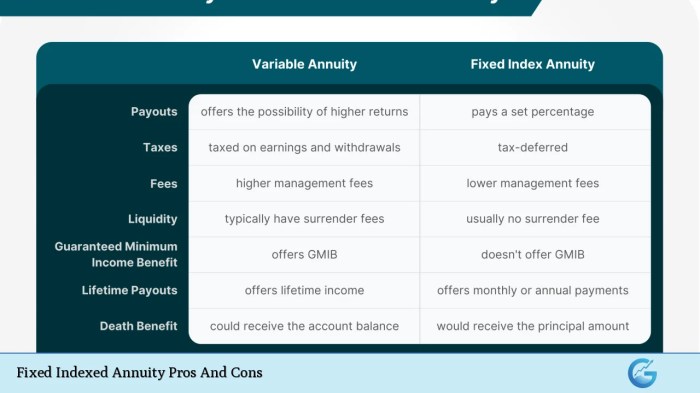
- Variable Annuities: Invest directly in market funds, offering higher potential returns but also exposing you to market risk. FIAs aim to offer a balance, providing growth potential with principal protection.
The Role of an Index in Determining Annuity Returns
The index, like the S&P 500, is the benchmark used to calculate your potential returns. The insurance company uses the index’s performance to determine how much interest to credit to your account. However, as mentioned earlier, the actual return is influenced by the participation rate, cap rate, and spread. These factors are crucial in understanding how much you’ll actually earn.
The participation rate determines how much of the index’s gains you receive. A higher participation rate means you benefit more directly from the index’s positive performance. The cap rate sets a limit on your potential earnings, offering a degree of predictability but potentially limiting your upside if the index performs exceptionally well. The spread is a deduction from the index’s gains, reducing the amount of interest credited to your account.
Understanding these factors is key to evaluating the potential returns of an FIA.
Example: Hypothetical Investment Performance Over Five Years
Let’s say a senior invests $100,000 in a Fixed Indexed Annuity. Here’s a simplified illustration of how the investment might perform over five years, considering different index performance scenarios, using a hypothetical participation rate of 70% and a cap rate of 6%.
| Year | Index Performance | Credited Interest | Account Value |
|---|---|---|---|
| 1 | 10% | 7% ($7,000) | $107,000 |
| 2 | 5% | 3.5% ($3,745) | $110,745 |
| 3 | 12% | 6% ($6,645) | $117,390 |
| 4 | -3% | 0% ($0)
|
$117,390 |
| 5 | 8% | 5.6% ($6,573.84) | $123,963.84 |
Note: This is a simplified example. Actual returns depend on the specific terms of the annuity contract and the actual performance of the chosen index.
The Potential Advantages of Fixed Indexed Annuities Deserve Careful Consideration
Fixed Indexed Annuities can offer several benefits that appeal to seniors looking for a secure retirement income. These advantages include principal protection, the potential for market-linked growth, and tax-deferred growth. However, it’s essential to weigh these benefits against the potential downsides.
Key Benefits of Fixed Indexed Annuities
One of the primary advantages of FIAs is principal protection. Your initial investment is protected from market downturns. Even if the index performs poorly, your account value will not decrease. This provides a sense of security, which is particularly important for retirees. Additionally, FIAs offer the potential for growth linked to market performance.
While you don’t directly invest in the market, your returns are tied to the performance of a chosen index, such as the S&P 500. This means you can benefit from market gains, unlike traditional fixed annuities, which offer a fixed interest rate regardless of market conditions. FIAs also offer tax-deferred growth. Any earnings in the annuity grow tax-deferred until you withdraw them in retirement, which can help your money grow faster over time.
Comparing Fixed Indexed Annuities

Here’s a comparison of FIAs with traditional fixed annuities and variable annuities, highlighting the key differences:
- Fixed Annuities:
- Risk Level: Low
- Potential Returns: Lower, based on a fixed interest rate.
- Fees: Generally lower, but with less growth potential.
- Variable Annuities:
- Risk Level: High, as investments are directly in the market.
- Potential Returns: Higher, but with the risk of losses.
- Fees: Higher, including investment management fees and administrative fees.
- Fixed Indexed Annuities:
- Risk Level: Moderate, principal protected, but returns depend on index performance.
- Potential Returns: Moderate, linked to market performance with caps and participation rates.
- Fees: Can be moderate, including surrender charges and other fees.
Providing a Guaranteed Income Stream and Flexibility
FIAs can be structured to provide a guaranteed income stream in retirement. You can annuitize the contract, which means converting your accumulated value into a stream of regular payments for life. The specific payout options vary, including options for joint life, where payments continue to a surviving spouse, or period certain, where payments are made for a specific duration. This guarantees a steady income, which can be a significant advantage for retirees.
FIAs also offer flexibility in terms of payout options. You can choose when and how to receive your income, providing some control over your retirement finances. This flexibility is a significant benefit for seniors who want to customize their retirement income strategy.
Exploring the Possible Downsides of Fixed Indexed Annuities is Essential for Informed Decisions
While Fixed Indexed Annuities offer several potential benefits, it’s crucial to understand their drawbacks before making a decision. These include the complexity of the contracts, the fees and charges associated with them, and the limitations on returns.
Potential Drawbacks of Fixed Indexed Annuities

FIAs can be complex financial products, making it difficult for some seniors to fully understand their terms and conditions. The contracts can be lengthy and contain complicated language regarding how interest is calculated, fees, and surrender charges. This complexity can make it challenging to compare different annuity products and understand the potential risks and rewards. Fees and charges can significantly impact the overall returns of an FIA.
These fees can erode the value of your investment over time, reducing the amount of income you receive in retirement. The limitations on returns are another significant drawback. While FIAs offer the potential for growth linked to market performance, they also have mechanisms like cap rates and participation rates that limit your upside. This means you won’t benefit fully from the market’s gains, especially during periods of strong market performance.
Additionally, the liquidity constraints of these annuities, such as surrender periods and potential penalties for early withdrawals, can affect a senior’s financial planning.
Types of Fees and Charges
Seniors should be aware of several fees and charges associated with FIAs. These fees can reduce your returns and affect your overall financial outcome. Common fees include:
- Surrender Charges: These are fees you pay if you withdraw your money before the end of the surrender period, which can last several years. The surrender charge percentage typically decreases over time.
- Mortality and Expense (M&E) Charges: These fees cover the insurance company’s expenses and mortality risk.
- Administrative Fees: These fees cover the cost of managing the annuity.
- Rider Fees: Additional fees for optional benefits, such as a lifetime income rider.
Here’s an example of how fees can impact returns over time:
Let’s say you invest $100,000 in an FIA with a 5% annual growth potential, but you are also charged an average of 1.5% in fees. After 20 years, your investment would grow to approximately $265,330 without fees. However, with fees, your investment would grow to only about $225,567. This demonstrates how fees can significantly reduce your returns over time.
Liquidity Constraints
FIAs have liquidity constraints that seniors need to consider. Most FIAs have a surrender period, during which you’ll be charged a fee if you withdraw your money. The surrender period can range from several years, typically 5 to 10 years, depending on the contract. Early withdrawals during the surrender period are subject to surrender charges, which can be a significant percentage of your investment.
This lack of liquidity can be a concern if you need access to your funds unexpectedly. Additionally, withdrawals before age 59 1/2 may be subject to a 10% federal tax penalty on the taxable portion of the withdrawal. This factor further restricts access to your funds. Understanding these liquidity constraints is essential for seniors planning for retirement.
Evaluating the Fees and Charges Associated with Fixed Indexed Annuities Demands Careful Scrutiny
Understanding the fees and charges associated with Fixed Indexed Annuities is crucial to assessing their overall value. These fees can significantly impact the returns you receive and should be carefully evaluated before making a purchase. This section provides a comprehensive overview of the fees and charges, comparing fee structures of different providers and demonstrating how to calculate actual returns after fees.
Overview of Fees and Charges
FIAs come with various fees and charges that can affect your returns. The fees are designed to cover the insurance company’s expenses, mortality risk, and administrative costs. The impact of fees can be substantial, as they directly reduce the amount of interest credited to your account or the value of your withdrawals. These fees can be complex, and understanding them is essential to make an informed decision.
Common fees and charges include surrender charges, mortality and expense charges, administrative fees, and rider fees. Surrender charges apply if you withdraw your money before the end of the surrender period. M&E charges cover the insurance company’s costs, and administrative fees cover the cost of managing the annuity. Rider fees are charged for optional benefits like a lifetime income rider.
The total amount of fees you pay depends on the specific annuity contract. Comparing the fee structures of different annuity providers is crucial to determine which product offers the best value. Some providers may have lower fees but offer lower potential returns, while others may have higher fees but offer a broader range of benefits. It is important to carefully review the terms and conditions of each annuity contract to understand the fees and charges before making a decision.
Comparing Fee Structures of Different Annuity Providers
Here’s a comparison of potential fee structures among different annuity providers. Remember that fee structures vary widely, and it’s essential to compare the specific terms of each contract.
| Provider | Surrender Charge Schedule | Mortality and Expense Charge | Other Fees |
|---|---|---|---|
| Provider A | 7% year 1, decreasing by 1% per year to 0% after 7 years | 0.75% annually | $25 annual administrative fee |
| Provider B | 8% year 1, decreasing by 1% per year to 0% after 8 years | 0.65% annually | None |
| Provider C | Varies by index strategy; some have no surrender charges | 0.85% annually | Fees for optional riders |
Calculating Actual Return After Fees
To calculate the actual return after fees, you must subtract all fees from the gross return. This will provide a more accurate picture of your investment’s performance. The calculation is as follows:
- Determine the gross return: This is the interest credited to your account before any fees are deducted.
- Calculate the total fees: This includes all applicable fees, such as surrender charges, M&E charges, and administrative fees.
- Subtract the total fees from the gross return: This will give you the net return, which is the actual return after fees.
Here’s an illustration of how fees impact returns. Suppose you invest $100,000 in an FIA with a 6% credited interest rate. However, you’re also charged a 1% M&E fee and a $25 annual administrative fee. In the first year, your gross interest is $6,000. The M&E fee is $1,000 (1% of $100,000), and the administrative fee is $25.
Your net return is $4,975 ($6,000 – $1,000 – $25), which is less than the gross return due to the impact of fees.
Understanding these fees and their impact is vital for making an informed decision about whether an FIA aligns with your retirement goals.
Understanding the Role of Riders and Optional Benefits in Fixed Indexed Annuities is Important
Fixed Indexed Annuities often come with riders, which are optional benefits that can be added to the contract for an additional cost. These riders provide extra features and flexibility, such as guaranteed income, death benefits, or long-term care benefits. This section will elaborate on the various riders and optional benefits available, the costs associated with them, and how they can enhance the value of your annuity.
Types of Riders and Optional Benefits
FIAs offer a variety of riders that provide additional benefits. These riders can tailor the annuity to meet your specific needs and financial goals. However, each rider comes with an additional cost, which will reduce your overall returns. Understanding the available riders and their associated costs is essential to determine if they’re a good fit for your situation. Some common types of riders include:
- Lifetime Income Riders:
- Provides a guaranteed income stream for life, regardless of market performance.
- Offers a guaranteed withdrawal benefit, ensuring a minimum income level.
- Often includes an annual fee, typically a percentage of the protected income base.
- Death Benefit Riders:
- Guarantees a death benefit to your beneficiaries, typically equal to the account value or a minimum guaranteed amount.
- Can offer a stepped-up death benefit, which increases the benefit over time.
- Involves an annual fee, usually a percentage of the account value.
- Long-Term Care Riders:
- Provides benefits to cover long-term care expenses.
- May offer a lump-sum payment or monthly payments for qualified care.
- Involves an annual fee and may have specific eligibility requirements.
- Enhanced Earnings Riders:
- May offer a higher participation rate or a lower spread, potentially increasing returns.
- Involves an annual fee, reducing the overall returns.
Example: Using a Lifetime Income Rider
A lifetime income rider provides a guaranteed income stream in retirement. This rider offers peace of mind, knowing that you will receive a regular income for the rest of your life. The income amount is based on factors such as your age, the amount invested, and the rider’s terms. While this rider provides a guaranteed income stream, it often comes with an annual fee.
However, the security of a guaranteed income can be a valuable addition to your retirement plan. Consider a senior, age 65, who invests $200,000 in an FIA with a lifetime income rider. The rider guarantees a 5% annual income, providing $10,000 per year for life. The rider also guarantees a growth of the income base, which can increase the income over time.
Here’s a visual representation of how the income stream might work:
Visual representation: A simple bar graph showing a steady income stream over time, starting at $10,000 per year and potentially increasing based on the terms of the rider. The graph clearly shows a constant flow of income for the retiree’s lifetime.
Conclusion
In conclusion, Fixed Indexed Annuities offer a compelling option for retirement planning, blending growth potential with downside protection. However, a thorough understanding of the contracts, fees, and limitations is essential. This article has provided a comprehensive look at the pros and cons, from the mechanics of index-linked returns to the impact of various charges and riders. Armed with this knowledge, you can evaluate whether a Fixed Indexed Annuity fits your needs, helping you make a confident and informed decision about your financial future.
User Queries
What is the primary benefit of a Fixed Indexed Annuity?
The main benefit is the potential for growth tied to a market index (like the S&P 500) while also protecting your principal from market downturns.
How is interest calculated on a Fixed Indexed Annuity?
Interest is typically calculated using a formula based on the performance of a chosen market index. The participation rate, cap rate, and spread determine how much of the index’s gains are credited to your account.
What are the common fees associated with these annuities?
Common fees include surrender charges (for early withdrawals), mortality and expense charges, and administrative fees. Riders (optional features) also come with associated costs.
Are Fixed Indexed Annuities suitable for everyone?
No, they’re not. They’re best suited for those seeking a balance between growth potential and principal protection, with a long-term investment horizon and a willingness to accept some limitations on returns.
What is a lifetime income rider?
A lifetime income rider guarantees a stream of income payments for the rest of your life, regardless of how the underlying investments perform.
