Navigating the world of retirement savings can feel complex, especially when you need access to your funds before traditional retirement age. While the standard rule dictates penalties for early IRA withdrawals, there are several exceptions that allow you to tap into your money without incurring those fees. This guide, Penalty-Free: How to Access Your IRA Funds Before Age 59.5 Legally, delves into these exceptions, providing a clear roadmap for those seeking early access to their retirement funds while staying compliant with IRS regulations.
We’ll explore various scenarios, from medical expenses and education costs to first-time home purchases and financial hardships, detailing the specific requirements, limitations, and documentation needed to qualify for penalty-free withdrawals. Understanding these options can provide financial flexibility during challenging times without jeopardizing your retirement savings. Let’s explore how to navigate these complexities and make informed decisions about your IRA funds.
Penalty-Free: How to Access Your IRA Funds Before Age 59.5 Legally
Navigating the world of Individual Retirement Accounts (IRAs) can sometimes feel like traversing a maze. While the primary goal of an IRA is to secure your financial future in retirement, life often throws curveballs. You might find yourself in a situation where you need access to your funds before you reach the traditional retirement age of 59.5. The good news is that, in certain circumstances, you can withdraw money from your IRA without incurring the standard penalties.
This article explores those scenarios, offering a comprehensive guide to understanding the rules, exceptions, and procedures involved.
Before diving in, it’s important to remember that this information is for educational purposes and should not be considered financial advice. Consulting with a qualified financial advisor is always recommended to assess your individual situation and make informed decisions.
Understanding the Fundamental Rules Governing Early IRA Withdrawals Before the Age of Fifty-Nine and a Half
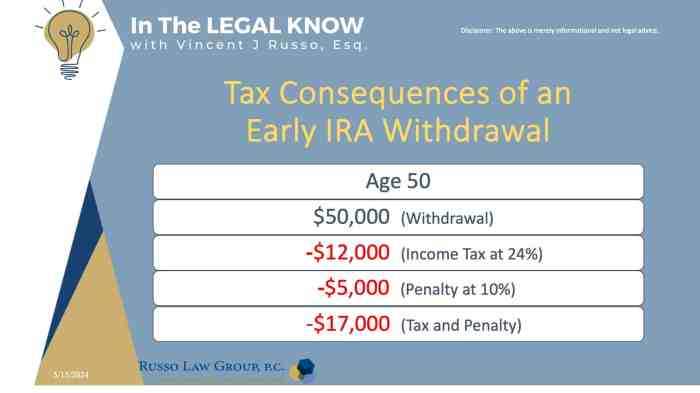
Generally, if you withdraw money from a traditional IRA before you turn 59.5, the IRS considers it an early withdrawal, and you’ll likely face a 10% penalty on the amount withdrawn, in addition to any applicable income taxes. This penalty is in place to discourage people from tapping into their retirement savings prematurely, as it can significantly impact their long-term financial security.
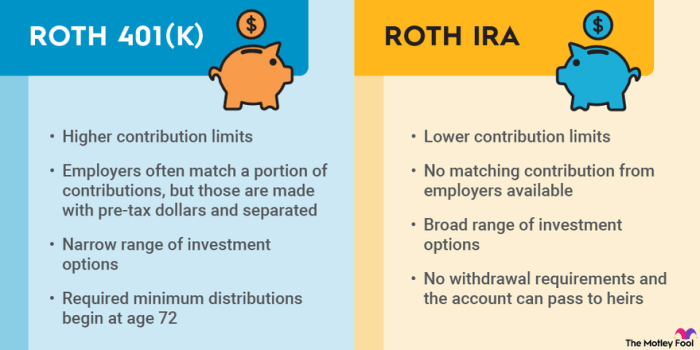
The rationale behind these regulations is straightforward: to preserve the integrity of the retirement system and ensure that funds are available when individuals truly need them for retirement. These rules are part of the broader framework designed to encourage long-term savings and provide tax benefits to those who save for retirement. The scope of these regulations is quite broad, applying to almost all types of IRAs, including traditional, Roth, SEP, and SIMPLE IRAs.
The penalties are designed to deter individuals from using retirement funds for non-retirement purposes, which could jeopardize their financial well-being in later years.
There are some exceptions to this rule. Certain circumstances, like substantial medical expenses or first-time home purchases, may allow you to withdraw funds without penalty. We’ll delve into those exceptions later.
It’s important to understand that the 10% penalty is separate from the income taxes you’ll owe on the withdrawn amount. The IRS views early withdrawals as taxable income in the year you take them. For example, if you withdraw $10,000 from a traditional IRA before 59.5, you might owe $1,000 in penalties (10% of $10,000) and then pay income taxes on the $10,000, depending on your tax bracket.
These rules are complex, and the specific details can vary. Always consult the IRS publications or a tax professional for the most up-to-date and accurate information.
Detail the specific tax implications of taking distributions before the standard retirement age, including the federal and potentially state income tax consequences, illustrating with examples of how these taxes are calculated and the impact on different income brackets, in 250 words.
Taking distributions from your IRA before age 59.5 triggers significant tax consequences. The amount you withdraw is generally considered taxable income for the year, just like your salary or wages. This means it will be added to your gross income, potentially pushing you into a higher tax bracket, and increasing the overall amount of taxes you owe. Additionally, the federal government will impose a 10% penalty on the withdrawn amount, unless an exception applies.
Let’s illustrate with an example. Suppose you’re in the 22% federal income tax bracket and withdraw $10,000 from a traditional IRA. You’ll owe $2,200 in federal income taxes (22% of $10,000) and $1,000 in early withdrawal penalties (10% of $10,000), totaling $3,200 in taxes and penalties. The tax implications can vary by state, as some states also tax retirement distributions.
For instance, if your state has a 5% income tax rate, you’d owe an additional $500 in state income taxes on the $10,000 withdrawal.
The impact of these taxes and penalties is more significant for higher-income earners. The higher your income, the higher your tax bracket, and the more you’ll pay in taxes on the withdrawal. This underscores the importance of understanding the tax implications before making any early withdrawals from your IRA.
Provide a clear comparison of the standard penalties for early withdrawals versus the exceptions that allow penalty-free access, highlighting the differences in financial outcomes, and include a simple table using HTML table tags to illustrate the comparison across four different scenarios, in 300 words.
The primary difference between standard early withdrawals and those made under an exception lies in the financial penalties incurred. Generally, early withdrawals from an IRA before age 59.5 trigger a 10% penalty on top of regular income taxes. However, certain exceptions allow you to access your funds without this penalty, although you still have to pay income taxes on the withdrawn amount from traditional IRAs.
The financial outcomes differ significantly. With a standard early withdrawal, you lose a portion of your savings to both taxes and penalties, reducing the amount available for your needs and diminishing the potential for future growth. With a penalty-free withdrawal, you only pay income taxes, preserving more of your retirement savings and allowing them to continue growing, potentially leading to a more secure financial future.
It’s crucial to understand the implications of each scenario to make informed decisions about your retirement funds.
Here’s a simple table comparing the outcomes across four different scenarios:
| Scenario | Withdrawal Amount | Penalty | Income Tax (Example: 22% Bracket) | Net Amount Received |
|---|---|---|---|---|
| Standard Early Withdrawal | $10,000 | $1,000 (10%) | $2,200 | $6,800 |
| Exception: Medical Expenses | $10,000 | $0 | $2,200 | $7,800 |
| Exception: First-Time Homebuyer | $10,000 | $0 | $2,200 | $7,800 |
| Exception: Substantially Equal Periodic Payments (SEPP) | $10,000 per year | $0 (if guidelines followed) | $2,200 per year | $7,800 per year |
Exploring the Substantial and Specific Exceptions Allowing Penalty-Free Withdrawals from an IRA
Several exceptions allow you to access your IRA funds before age 59.5 without incurring the 10% penalty. These exceptions are designed to provide financial relief in specific situations, such as significant medical expenses or the purchase of a first home. However, it’s essential to understand the conditions and limitations associated with each exception to avoid unintended tax consequences.
Discuss the “Substantially Equal Periodic Payments” (SEPP) rule, including the conditions for qualification, the methods for calculating payments, and the risks associated with this strategy, offering practical examples of how to implement a SEPP plan and the potential pitfalls to avoid, in 400 words.
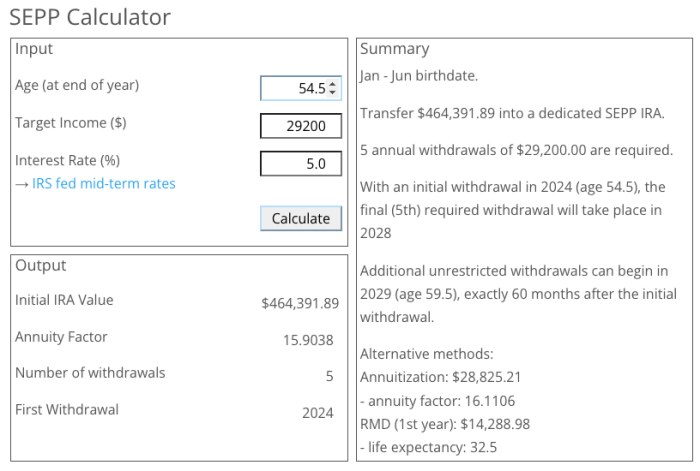
The “Substantially Equal Periodic Payments” (SEPP) rule, also known as IRS Code Section 72(t)(2)(A)(iv), provides an exception to the early withdrawal penalty if you take a series of substantially equal periodic payments (SEPP) from your IRA. This method allows you to access your retirement funds before 59.5 without penalty, provided you meet specific requirements.
To qualify for SEPP, you must follow a specific payment schedule calculated using one of three IRS-approved methods: the required minimum distribution (RMD) method, the fixed amortization method, or the fixed annuitization method. Each method has its own calculation rules, which consider your account balance, life expectancy, and interest rates. You must continue these payments for at least five years or until you reach age 59.5, whichever is later.
Failing to adhere to this schedule triggers the 10% penalty, plus interest, for all previous withdrawals.
The RMD method is the simplest, based on your account balance and life expectancy factors. The fixed amortization method calculates payments based on your account balance, a fixed interest rate, and your life expectancy. The fixed annuitization method uses your account balance and an annuity factor provided by the IRS to determine payments. The IRS provides detailed instructions and calculation tables for each method.
Implementing a SEPP plan requires careful planning. First, you must choose a calculation method and calculate your payments. Then, you’ll need to work with your IRA custodian to set up the payment schedule. It’s crucial to document everything meticulously, including the calculation method, payment amounts, and start date. If you change your mind and want to stop the payments before the required timeframe, the IRS will likely assess the 10% penalty on all previous withdrawals, plus interest.
For example, if you have an IRA balance of $200,000 and use the RMD method, your annual payments might be $8,000. You’d need to continue these payments for at least five years or until you turn 59.5. The primary risk is that if you need to stop the payments early, the IRS will assess the penalties. Another risk is that the payments might not be sufficient to cover your needs, especially if your expenses increase.
Also, the SEPP payments are taxable income.
Detail the exception for qualified higher education expenses, outlining the eligible expenses, the limits on withdrawals, and the documentation needed to prove eligibility, including a bulleted list of the types of educational expenses covered, in 280 words.
You can withdraw funds from your IRA without penalty to pay for qualified higher education expenses for yourself, your spouse, your child, or your grandchild. There is no specific limit on the amount you can withdraw, but the withdrawn amount is still considered taxable income. This means that while you avoid the 10% penalty, you still have to pay income taxes on the amount withdrawn.
It is important to remember that these withdrawals are subject to the same tax rules as any other IRA withdrawal.
To claim this exception, you must be able to prove that the funds were used for qualified education expenses. This usually means providing documentation such as tuition bills, receipts for required fees, books, supplies, and room and board costs if the student is enrolled at least half-time. You’ll need to keep records of your withdrawals and the related expenses. This documentation should be readily available if the IRS asks for proof.
Qualified education expenses include:
- Tuition and fees required for enrollment.
- Books, supplies, and equipment needed for a course of study.
- Room and board, if the student is enrolled at least half-time.
- Expenses for graduate-level courses.
Keep in mind that if the student receives scholarships or grants, the qualified education expenses are reduced by the amount of those benefits.
Elaborate on the exception for first-time homebuyers, describing the conditions that must be met, the maximum withdrawal amount allowed, and how the funds can be used, alongside a brief discussion on the potential impact on future retirement savings, in 350 words.
The IRS allows you to withdraw up to $10,000 from your IRA to help pay for the purchase of your first home without incurring the 10% penalty. This exception is designed to assist individuals in achieving homeownership, which is often a significant financial milestone. However, there are specific conditions and limitations you must meet to qualify.
To be considered a first-time homebuyer, you generally must not have owned a home in the past two years. The funds can be used for various home-buying expenses, including the down payment, closing costs, and other related fees. The $10,000 limit applies to your lifetime, not annually. If you and your spouse both have IRAs, you can each withdraw up to $10,000, for a total of $20,000, to help with the purchase.
The funds must be used within 120 days of the withdrawal. You’ll need to keep records of your withdrawal and the use of the funds. This includes your settlement statement, mortgage documents, and any other relevant documentation that supports the use of the funds for the home purchase. You will still have to pay income taxes on the withdrawn amount.
While this exception can be a valuable tool for homeownership, it’s essential to consider its impact on your retirement savings. Taking money out of your IRA means less money available to grow and compound over time, which could affect your financial security in retirement. If possible, consider replenishing your IRA after the home purchase to mitigate the long-term impact on your retirement savings.
Also, if you use the funds and the home purchase falls through, you might have to put the money back in your IRA within 60 days to avoid the taxes and penalties.
Examining the Exceptions Related to Medical Expenses and Hardship Circumstances
In addition to the exceptions we’ve already discussed, the IRS provides relief for those facing significant medical expenses or other hardship circumstances. These exceptions allow you to access your IRA funds without penalty, providing financial assistance when it’s most needed. However, it’s crucial to understand the specific requirements and limitations to ensure compliance with IRS regulations.
Explain the exception for unreimbursed medical expenses, detailing the requirements for eligibility, the types of medical expenses that qualify, and the calculation of the deductible amount, including a step-by-step procedure of how to claim the exception, in 380 words.
The IRS allows penalty-free withdrawals from an IRA to cover unreimbursed medical expenses. This exception is available to those who have significant medical bills that are not covered by insurance or other sources. This provides a safety net for individuals facing unexpected healthcare costs.
To qualify, you must have medical expenses that exceed 7.5% of your adjusted gross income (AGI). Only the amount exceeding this threshold qualifies for penalty-free withdrawal. The eligible medical expenses include those defined in Section 213(d) of the Internal Revenue Code. These expenses include diagnosis, cure, mitigation, treatment, or prevention of disease, or for the purpose of affecting any structure or function of the body.
Examples include doctor visits, hospital stays, prescription medications, and insurance premiums. However, cosmetic surgery that is not medically necessary is generally not included.
Here’s a step-by-step procedure to claim the exception:
- Calculate your AGI.
- Multiply your AGI by 7.5% to determine the threshold.
- Total your unreimbursed medical expenses for the year.
- Subtract the threshold (from step 2) from your total medical expenses. The result is the amount eligible for penalty-free withdrawal.
- Withdraw the necessary funds from your IRA.
- Report the withdrawal on your tax return and claim the medical expense deduction if you itemize.
- Keep detailed records of your medical expenses, including bills, receipts, and insurance statements.
For example, if your AGI is $50,000, your threshold is $3,750 (7.5% of $50,000). If your unreimbursed medical expenses are $10,000, you can withdraw $6,250 ($10,000 – $3,750) from your IRA without penalty, although you will still have to pay income taxes on the withdrawn amount. You will need to keep records of all the expenses.
Provide an overview of the exception for disability, defining what constitutes a disability under IRS guidelines and the documentation required to prove disability, including the impact of these withdrawals on other government benefits, in 270 words.
The IRS allows penalty-free withdrawals from an IRA for individuals who are disabled. This exception provides financial support to those who may be unable to work and need access to their retirement funds.
According to the IRS, you are considered disabled if you can provide a doctor’s statement that you have a physical or mental impairment that prevents you from engaging in any substantial gainful activity. The impairment must be expected to result in death or to last for a continuous period of not less than 12 months. This definition aligns with the Social Security Administration’s (SSA) definition of disability.
To claim this exception, you must provide documentation to your IRA custodian. This documentation typically includes a letter from your doctor stating that you meet the IRS’s definition of disability. You may also need to provide documentation from the SSA if you are receiving Social Security disability benefits. It’s crucial to keep all records related to your disability and the IRA withdrawal.
It’s important to consider the potential impact of these withdrawals on other government benefits. Taking money out of your IRA may affect your eligibility for means-tested programs, such as Medicaid or Supplemental Security Income (SSI). Consult with a financial advisor or benefits specialist to understand the potential implications.
Discuss the exceptions related to financial hardship, like the IRS rule for hardship distributions, including how these exceptions work, and under what circumstances they can be applied, providing examples of qualifying hardships, along with a blockquote of an IRS statement on this topic, in 420 words.
While the IRS doesn’t have a specific “hardship distribution” rule for traditional IRAs like it does for 401(k) plans, there are several circumstances that might be considered as hardships, and you may be able to withdraw funds from your IRA without penalty. These situations typically involve significant and unexpected financial difficulties.
The IRS generally allows penalty-free withdrawals for medical expenses (as discussed earlier), disability, and first-time homebuyers. However, other circumstances may also be considered, though these are often based on the specific rules of your IRA plan, if applicable. These plans might have more flexibility than a standard IRA.
Examples of qualifying hardships include:
- Unforeseen medical bills that are not covered by insurance.
- The threat of foreclosure or eviction from your primary residence.
- Loss of employment and the inability to find new work.
- Damage to your primary residence due to a natural disaster.
- Funeral expenses for a spouse, child, parent, or other dependent.
The key factor is that the hardship must be immediate and severe, and the withdrawal must be necessary to alleviate the financial burden. You will still have to pay income taxes on the withdrawn amount.
It’s important to consult your IRA custodian and potentially a tax professional to determine if your situation qualifies. Be prepared to provide documentation to support your claim. The IRS doesn’t explicitly define “hardship” for traditional IRAs, so the specifics can vary. Always keep records to support your withdrawal.
“Generally, you can’t withdraw funds from your IRA before age 59 1/2 without paying a 10% additional tax on the amount you withdraw. However, there are exceptions. For example, the 10% additional tax doesn’t apply to distributions you take because you are disabled, or for certain medical expenses.”
-IRS Publication 590-B, Distributions from Individual Retirement Arrangements (IRAs)
Navigating the Procedures for Claiming Penalty-Free IRA Withdrawals
Accessing your IRA funds penalty-free requires following specific procedures and providing the necessary documentation to support your claim. This section provides a practical guide to navigate the process smoothly and avoid potential issues.
Describe the steps involved in requesting an early withdrawal from an IRA, including the forms to complete, the information needed, and the timeframes involved, providing practical advice on how to navigate the process smoothly, in 290 words.
The process of requesting an early withdrawal from your IRA, even under an exception, generally involves several steps. The specific procedures can vary depending on your IRA custodian, but the general steps are similar.
First, contact your IRA custodian. They will provide you with the necessary forms, which usually include a withdrawal request form and possibly a form to report the reason for the withdrawal. You will need to provide your personal information, the amount you wish to withdraw, and the reason for the withdrawal. Be prepared to provide details about the exception you are claiming, such as medical expenses or first-time homebuyer status.
You’ll also need to specify how you want to receive the funds (e.g., check, direct deposit). Carefully review the forms and ensure all information is accurate. The timeframe for processing the withdrawal can vary, but it typically takes a few days to a few weeks. After your request is processed, you will receive the funds, along with a 1099-R form from your IRA custodian.
This form reports the distribution to the IRS.
To navigate the process smoothly, keep all your records organized, and contact your IRA custodian immediately if you have any questions. Verify the instructions on the forms and ask for clarification if anything is unclear. It’s always a good idea to submit your request well in advance of when you need the funds to avoid delays. Also, keep copies of all forms for your records.
Detail the necessary documentation to support the claim of an exception, including what records to keep and how to submit them to the IRS, offering examples of how to properly organize and present the required information, in 310 words.
When claiming an exception to the early withdrawal penalty, it’s essential to have the necessary documentation to support your claim. This documentation is crucial in case the IRS questions your withdrawal. The specific documentation required depends on the exception you are claiming, but certain general principles apply.
Keep detailed records of all the relevant expenses or events. For example, if you are claiming the medical expense exception, keep copies of all medical bills, insurance statements, and payment records. If you’re claiming the first-time homebuyer exception, keep your home purchase agreement, settlement statement, and mortgage documents. If you are using the disability exception, gather a doctor’s statement confirming your disability and any Social Security documentation.
Organize your documentation chronologically and by category. Create a file for each exception you are claiming. Within each file, include copies of the withdrawal request form, the 1099-R form, and all supporting documentation. Make sure that all the documentation is easily accessible. You don’t need to submit this documentation with your tax return unless the IRS specifically requests it.
However, it’s crucial to keep it for at least three years from the date you filed your return, or two years from the date you paid the tax, whichever is later.
If the IRS does contact you, respond promptly and provide the requested documentation. Providing well-organized and complete documentation will significantly increase your chances of a successful outcome.
Illustrate potential scenarios where withdrawals might be challenged by the IRS and how to prepare for such an event, including advice on how to respond to IRS inquiries and the importance of keeping detailed records, along with a bulleted list of common mistakes that lead to IRS challenges, in 450 words.
Even if you believe you qualify for an exception, the IRS may challenge your early IRA withdrawal. This is often because of unclear documentation, insufficient proof of eligibility, or misunderstandings of the rules. Being prepared for a potential challenge is crucial to protect your financial interests.
One potential scenario is when the IRS questions the validity of your claimed exception. For example, if you claim the medical expense exception, the IRS may ask for additional documentation to verify that the expenses were indeed for medical care. Another scenario is if the IRS believes that you didn’t meet all the conditions of the exception. For instance, if you claimed the first-time homebuyer exception but didn’t use the funds within the required timeframe, the IRS could deny the exception and assess the penalty.
If the IRS contacts you, respond promptly and professionally. Gather all the relevant documentation and provide it in a clear, organized manner. Don’t ignore the IRS’s inquiry, as this can lead to further complications. If you’re unsure how to respond, consider consulting with a tax professional. Keeping detailed records is paramount.
This includes all documentation related to your IRA, the withdrawal, and the exception you are claiming. This documentation serves as your primary defense in case of an IRS challenge.
Here are some common mistakes that can lead to IRS challenges:
- Not having adequate documentation to support the claim.
- Misunderstanding the rules and conditions of the exception.
- Failing to use the withdrawn funds for the intended purpose.
- Not reporting the withdrawal correctly on your tax return.
- Making a withdrawal that exceeds the allowed limit for the exception.
- Not meeting the timeframes associated with the exception, such as using the funds within 120 days for a home purchase.
By understanding these potential challenges and taking the necessary precautions, you can minimize the risk of IRS scrutiny and protect your retirement funds.
Closure
In conclusion, accessing your IRA funds before age 59.5 without penalties is possible, provided you meet specific criteria Artikeld by the IRS. From understanding the SEPP rule to navigating exceptions for medical expenses, education, and other hardships, this guide has provided you with the necessary knowledge to make informed decisions. Remember to carefully document everything and consult with a financial advisor to ensure you meet all requirements and make the best choice for your unique situation.
By understanding the rules and exceptions, you can safeguard your financial future while addressing immediate needs.
FAQ Summary
What is the standard penalty for early IRA withdrawals?
Generally, you’ll face a 10% penalty on top of your regular income tax liability if you withdraw from your IRA before age 59.5.
Are there any limits on how much I can withdraw penalty-free?
Yes, limits vary depending on the exception. For example, first-time homebuyers have a limit, while other exceptions, like medical expenses, may only allow for withdrawals to cover unreimbursed costs.
Do I need to report these withdrawals to the IRS?
Yes, all IRA withdrawals, including those taken under exceptions, must be reported on your tax return. You’ll receive a 1099-R form from your IRA provider detailing the distribution.
Can I put the money back into my IRA later?
In some cases, yes. For example, if you use the funds for a first-time home purchase, you can potentially make contributions to replenish the funds later. The specifics depend on the exception used.
