Asset Protection 101: Revocable vs. Irrevocable Trusts Explained dives into the core of safeguarding your wealth. Understanding the nuances between revocable and irrevocable trusts is key to protecting your assets from potential threats like lawsuits, creditors, and estate taxes. This guide offers a clear, comprehensive look at how these trusts work, their benefits, and their drawbacks, helping you make informed decisions about your financial future.
We’ll explore the fundamental differences, from grantor control to tax implications, and delve into the mechanics of setting up and managing each type. Whether you’re planning for your family’s future, looking to shield your assets, or simply curious about these powerful financial tools, this is your starting point. Prepare to gain a solid grasp of trust structures and how they can be tailored to your specific needs and long-term financial goals.
Understanding the Fundamental Differences Between Revocable and Irrevocable Trusts is Paramount for Effective Asset Protection

Understanding the difference between revocable and irrevocable trusts is crucial for anyone looking to protect their assets. These two types of trusts offer distinct advantages and disadvantages, and choosing the right one depends heavily on your specific needs and goals. This article will break down the core distinctions, tax implications, and practical considerations for both revocable and irrevocable trusts.
Essentially, a trust is a legal arrangement where a person (the grantor) transfers assets to another person or entity (the trustee) to be held for the benefit of a third party (the beneficiary). The key differences between revocable and irrevocable trusts lie in the grantor’s ability to control and access the assets within the trust.
Core Distinction: Grantor’s Control and Ownership
The primary distinction between revocable and irrevocable trusts centers on the level of control the grantor retains over the assets. In a revocable trust, also known as a living trust, the grantor maintains complete control. They can modify, amend, or even revoke the trust at any time during their lifetime. This means the grantor retains ownership of the assets within the trust, and these assets are still considered part of their estate for tax purposes.
The grantor can also act as the trustee, managing the assets themselves. This flexibility makes revocable trusts attractive for estate planning purposes, as they allow for easy adjustments to reflect changing circumstances or wishes.
Conversely, an irrevocable trust, as the name suggests, is generally permanent once established. The grantor relinquishes control of the assets, and they are no longer considered part of the grantor’s estate. The grantor cannot typically modify or revoke the trust, and the trustee (who can be a third party or the grantor, depending on the trust’s structure) has a fiduciary duty to manage the assets according to the terms of the trust document.
This lack of control is the key feature that makes irrevocable trusts powerful tools for asset protection, as the assets are shielded from creditors and lawsuits. However, this also means the grantor loses direct access to and control over the assets.
Tax Implications: A Comparative Analysis

The tax implications of revocable and irrevocable trusts differ significantly. In a revocable trust, the grantor is still responsible for paying taxes on the income generated by the trust assets. This is because the IRS views the grantor as the owner of the assets. For estate tax purposes, the assets in a revocable trust are included in the grantor’s taxable estate.
Gift taxes are generally not a concern during the grantor’s lifetime, as the transfer of assets to a revocable trust is not considered a completed gift.
In contrast, irrevocable trusts offer potential tax advantages. Depending on the trust’s structure, the income generated by the trust assets may be taxed at the trust level, potentially at a lower rate than the grantor’s individual income tax rate. Furthermore, assets held in an irrevocable trust are typically not included in the grantor’s taxable estate, which can reduce estate tax liabilities.
However, transferring assets to an irrevocable trust may be considered a completed gift, potentially triggering gift tax implications. Careful planning and consultation with a tax professional are essential to understand the specific tax consequences of each type of trust.
Key Benefits and Drawbacks of Revocable Trusts
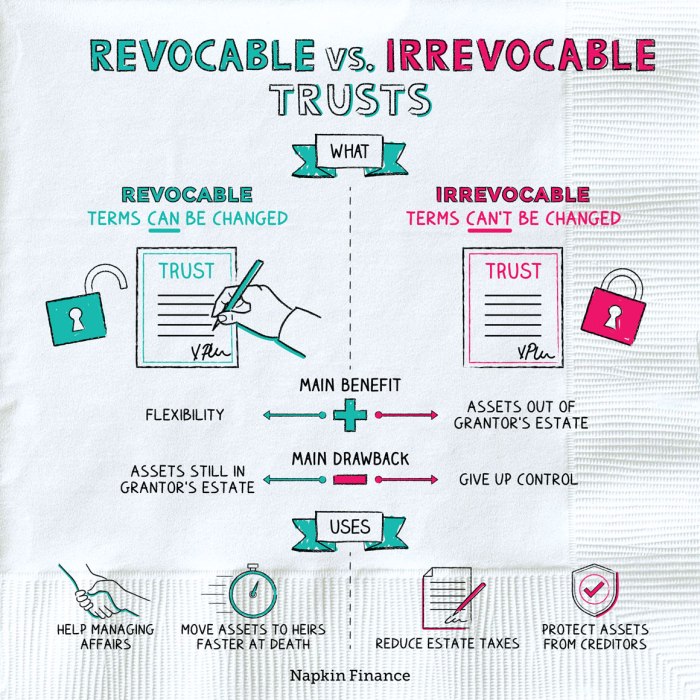
Revocable trusts offer several advantages, making them a popular choice for estate planning. However, they also come with certain limitations.
- Benefits:
- Flexibility: The grantor retains complete control and can modify or revoke the trust at any time.
- Avoidance of Probate: Assets held in a revocable trust avoid the often lengthy and costly probate process.
- Privacy: Trust documents are generally private, unlike wills, which become public record during probate.
- Management: The grantor can manage the assets themselves, serving as the trustee.
- Drawbacks:
- No Asset Protection: Assets in a revocable trust are still vulnerable to creditors and lawsuits.
- Estate Tax Inclusion: Assets are included in the grantor’s taxable estate, potentially subject to estate taxes.
- No Tax Advantages: Revocable trusts generally do not offer significant tax benefits during the grantor’s lifetime.
Wrap-Up
In summary, Asset Protection 101: Revocable vs. Irrevocable Trusts Explained has illuminated the distinct roles of these crucial asset protection tools. From the flexibility of revocable trusts to the robust protection offered by irrevocable trusts, the right choice hinges on your unique circumstances and objectives. By understanding the intricacies of each type, you’re empowered to build a strong financial foundation, protect your legacy, and navigate the complexities of estate planning with confidence.
Remember to seek professional advice to tailor these strategies to your individual needs.
FAQ Section
What is the primary difference between a revocable and an irrevocable trust?
The main difference lies in control. A revocable trust can be changed or canceled by the grantor, while an irrevocable trust generally cannot be altered once established.
Can I be the trustee of my own revocable trust?
Yes, you can typically serve as your own trustee for a revocable trust, maintaining control over your assets.
Are assets in an irrevocable trust protected from creditors?
Generally, yes. Assets in a properly structured irrevocable trust are often shielded from creditors, offering a significant asset protection benefit.
What happens to a revocable trust when the grantor dies?
The revocable trust becomes irrevocable upon the grantor’s death, and the assets are distributed according to the trust’s terms, often avoiding probate.
How are trusts taxed?
Revocable trusts are generally taxed as if the grantor still owns the assets. Irrevocable trusts have their own tax ID and are taxed differently, potentially offering tax advantages.
