Grandparent-Owned 529 Plans: New FAFSA Rules You Need to Know is a deep dive into how these college savings plans work, especially in light of recent changes to the Free Application for Federal Student Aid (FAFSA). Many families are utilizing grandparent-owned 529 plans as a smart way to save for college, but the FAFSA rules can significantly impact how much financial aid a student receives.
This guide will break down the mechanics of these plans, compare them to other savings options, and provide practical tips for navigating the FAFSA process. We’ll also cover the tax implications and explore how financial advisors can help you make the most of your 529 plan, ensuring you’re well-prepared for any situation.
Grandparent-Owned 529 Plans: New FAFSA Rules You Need to Know
Navigating the world of college savings can feel like a complex maze, especially with ever-changing financial aid rules. Grandparent-owned 529 plans have become a popular tool for families looking to help with education costs, but recent changes to the Free Application for Federal Student Aid (FAFSA) have significantly impacted how these plans are treated. This article will break down everything you need to know about grandparent-owned 529 plans, the new FAFSA rules, and how to make informed decisions for your family’s college savings strategy.
We’ll cover the basics of these plans, the implications of the new regulations, and provide practical advice to help you maximize your financial aid eligibility. Let’s dive in.
Understanding the Role of Grandparent-Owned 529 Plans in College Savings
Grandparent-owned 529 plans offer a unique approach to college savings, distinct from plans managed by parents. Understanding their mechanics, advantages, and differences is crucial for effective planning.
Here’s a breakdown of how these plans work:
- Mechanics: Grandparents open and manage the 529 plan, contributing funds regularly or in lump sums. These contributions are invested in various options, such as mutual funds or age-based portfolios, which grow tax-deferred. When the beneficiary (usually a grandchild) is ready for college, the funds can be used for qualified educational expenses, including tuition, fees, books, and sometimes room and board.
- How They Differ from Parent-Owned Plans: The key difference lies in control and asset ownership. In a grandparent-owned plan, the grandparent retains control and ownership of the assets. In a parent-owned plan, the parents own and control the funds. This distinction has significant implications for financial aid eligibility, as we’ll see later.
- Benefits: Grandparent-owned 529 plans offer several advantages. They can be a valuable tool for estate planning, allowing grandparents to reduce the taxable value of their estate while still benefiting their grandchildren. They also provide flexibility in investment choices, allowing grandparents to tailor their investments to their risk tolerance and time horizon.
Detailing the New FAFSA Rules and Their Impact on Grandparent-Owned 529 Plans
The latest updates to the FAFSA regulations have reshaped how grandparent-owned 529 plans are considered when determining a student’s eligibility for financial aid. These changes are critical for families to understand.
Here’s a closer look at the changes and their potential consequences:
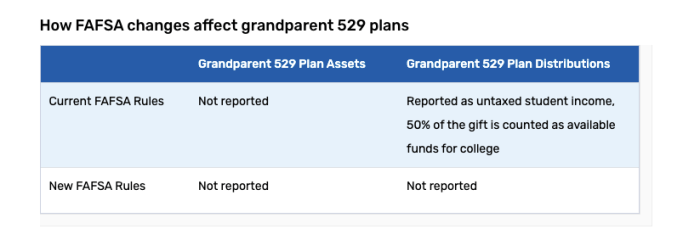
- Specific Changes in FAFSA Regulations: Previously, distributions from grandparent-owned 529 plans were often treated as untaxed income to the student on the FAFSA. Under the new rules, assets in a grandparent-owned 529 plan are
-not* considered an asset of the student or parent. Instead, distributions from these plans are now considered “available resources” and treated as student income. - Potential Consequences: This change can have a significant impact on aid eligibility. While the assets themselves don’t directly affect eligibility, the distributions, which are treated as student income, can reduce the amount of aid a student receives. This is because a portion of the student’s income is typically used to determine the Expected Family Contribution (EFC).
- Scenarios Where the New Rules Create Challenges or Opportunities:
- Scenario 1: High Distributions, Reduced Aid: If a grandparent makes a large distribution in a single year, it will be treated as a large amount of student income. This can significantly reduce the student’s eligibility for need-based aid, such as Pell Grants or subsidized loans.
- Scenario 2: Strategic Timing of Distributions: Families might now consider the timing of distributions more carefully. Waiting until the final year of college to take a distribution could be beneficial, as it wouldn’t impact aid eligibility in the earlier years. However, this strategy carries the risk of not having enough funds if the student drops out or doesn’t attend college.
- Scenario 3: Coordinating with Parent Contributions: Families may need to coordinate contributions from parents and distributions from grandparents. If parents contribute significantly to a parent-owned 529 plan, it may reduce the need for distributions from the grandparent’s plan, potentially minimizing the impact on financial aid.
Navigating the FAFSA Application Process with Grandparent-Owned 529 Plans
Accurately reporting grandparent-owned 529 plan assets on the FAFSA is essential. Here’s a step-by-step guide and some practical tips to help you navigate the process.
Here’s how to correctly report the information:
- Step-by-Step Guide for Reporting:
- Student Section: The student will report their income.
- Asset Section: Grandparent-owned 529 plans are not reported as an asset of the student or parent.
- Income Section: Any distributions from the grandparent-owned 529 plan
-during the tax year* (the year before the aid year) are reported as student income. This information will be available on the student’s tax forms or through a statement from the 529 plan provider. - Reporting the Distribution: The amount of the distribution is entered in the “student income” section of the FAFSA.
- Tips to Minimize Negative Impact:
- Coordinate Distributions: Plan distributions strategically to avoid large sums in any single year.
- Consider Parent Contributions: If possible, use parent-owned 529 plans or other savings methods to reduce the reliance on grandparent-owned plans.
- Explore Other Aid Options: Research scholarships and grants to offset any potential loss of need-based aid.
- Common Mistakes and Solutions:
- Mistake: Reporting the 529 plan as an asset: This is incorrect.
- Solution: Do not report the plan as an asset. Only report the distributions as student income.
- Mistake: Incorrectly reporting the distribution amount:
- Solution: Obtain the correct distribution amount from the student’s tax forms or 529 plan statements.
- Mistake: Failing to account for the impact on the EFC:
- Solution: Understand that the distributions will likely increase the student’s EFC, potentially reducing aid eligibility.
Comparing Different Strategies for College Savings with and without Grandparent Involvement
Choosing the right college savings strategy involves weighing various options. Comparing grandparent-owned 529 plans with other methods helps families make informed decisions.
Here’s a comparison of different college savings options:
- Parent-Owned 529 Plans: These plans offer tax advantages and are owned and controlled by the parents. Assets are considered parental assets on the FAFSA, which has a smaller impact on financial aid eligibility than student assets.
- Coverdell Education Savings Accounts (ESAs): ESAs allow for tax-free growth and withdrawals for qualified educational expenses. However, contribution limits are lower than those for 529 plans.
- Custodial Accounts (UGMA/UTMA): These accounts are managed by a custodian for the benefit of a minor. While they offer flexibility, the assets are considered the student’s on the FAFSA, which can significantly reduce financial aid eligibility.
To integrate grandparent-owned 529 plans into a comprehensive strategy, consider the following:
- Coordination: Coordinate contributions and distributions with parent-owned plans and other savings vehicles.
- Communication: Maintain open communication with grandparents about financial aid implications and college costs.
- Diversification: Diversify savings across different accounts to maximize benefits and mitigate risks.
Understanding the Tax Implications of Grandparent-Owned 529 Plans

Grandparent-owned 529 plans come with their own set of tax benefits and considerations. Understanding these can help you maximize the advantages and avoid potential pitfalls.
Here’s a breakdown of the tax implications:
- Tax Benefits:
- Tax-Advantaged Growth: Investments grow tax-deferred, meaning you don’t pay taxes on earnings as long as the funds remain in the plan.
- State Tax Deductions: Many states offer tax deductions for contributions to 529 plans, which can reduce your taxable income.
- Tax Implications of Distributions:
- Qualified Educational Expenses: When funds are used for qualified educational expenses, such as tuition, fees, books, and sometimes room and board, the earnings are tax-free.
- Non-Qualified Expenses: If funds are used for non-qualified expenses, the earnings portion of the distribution is subject to federal and potentially state income taxes, plus a 10% penalty.
- Circumstances Leading to Taxes or Penalties:
- Non-Qualified Withdrawals: Using funds for expenses that don’t qualify can trigger taxes and penalties.
- Changing Beneficiary: While you can change the beneficiary to another family member, changing the beneficiary to someone outside the family can have tax implications.
- Excess Funds: If there are excess funds left in the plan after the beneficiary graduates, you may face taxes and penalties if you don’t use the funds for other qualified expenses or change the beneficiary. For example, if a student receives a full scholarship and no longer needs the 529 plan funds, the earnings portion of the distribution used for non-qualified expenses will be taxed.
Exploring the Role of Financial Advisors in Managing Grandparent-Owned 529 Plans

Financial advisors can provide valuable assistance in setting up and managing grandparent-owned 529 plans. Their expertise can help families make informed decisions and optimize their college savings strategy.
Here’s how financial advisors can assist:
- Assistance Provided:
- Plan Selection: Advisors can help you compare different 529 plans based on your state’s offerings, investment options, and fees.
- Investment Selection: They can recommend appropriate investment portfolios based on your risk tolerance and time horizon.
- Contribution Strategies: Advisors can help you determine the optimal contribution amounts and frequency.
- Tax Planning: They can provide guidance on maximizing tax benefits and minimizing potential tax liabilities.
- Financial Aid Planning: Advisors can help you understand the impact of 529 plans on financial aid eligibility and develop strategies to mitigate any negative effects.
- Questions to Ask When Choosing an Advisor:
- Experience: How long have you been advising clients on 529 plans?
- Expertise: Do you specialize in college savings and financial aid planning?
- Fiduciary Duty: Are you a fiduciary, meaning you are legally obligated to act in the best interests of your clients?
- Fees: How are you compensated? (e.g., commission, fee-based)
- Services: What specific services do you offer related to 529 plans?
- Resources for Research and Comparison:
- Savingforcollege.com: Provides comprehensive information on 529 plans, including plan comparisons and articles.
- Morningstar.com: Offers ratings and analysis of 529 plans and investment options.
- Your State’s 529 Plan Website: Provides details on the specific 529 plan options available in your state.
- The College Savings Plans Network (CSPN): Offers resources and information about 529 plans nationwide.
Preparing for Unexpected Situations with Grandparent-Owned 529 Plans
Life can be unpredictable. Planning for unexpected events related to grandparent-owned 529 plans ensures you’re prepared for any scenario.
Here’s how to handle different situations:
- Death of the Grandparent:
- Succession Plan: The 529 plan documents typically specify a successor owner. If the grandparent dies, the plan ownership transfers to the designated successor.
- Tax Implications: The funds remain in the plan, and the successor owner takes over management. There are no immediate tax implications unless distributions are taken.
- Student Doesn’t Attend College:
- Change Beneficiary: The plan owner can change the beneficiary to another eligible family member.
- Non-Qualified Withdrawal: If there are no other eligible beneficiaries, the plan owner can take a non-qualified withdrawal, which will be subject to taxes and penalties on the earnings portion.
- Market Downturns:
- Rebalance Investments: Adjust the portfolio to maintain the desired asset allocation.
- Consider a Conservative Strategy: As the beneficiary gets closer to college, shift investments to more conservative options to protect the principal.
- Stay Focused: Avoid making emotional decisions based on short-term market fluctuations.
- Consult with an Advisor: Seek professional advice on managing your investments during market volatility.
Illustrating Real-Life Examples of Grandparent-Owned 529 Plan Strategies
Real-life examples demonstrate how families can successfully utilize grandparent-owned 529 plans to achieve their college savings goals.
Here are some examples of successful strategies:
- Case Study 1: Early Contributions and Long-Term Growth: A grandparent started contributing to a 529 plan shortly after their grandchild’s birth. They chose a diversified portfolio and contributed regularly. By the time the grandchild was ready for college, the plan had grown significantly, covering a substantial portion of the tuition costs.
- Case Study 2: Strategic Distribution Timing: A family strategically timed distributions from the grandparent’s 529 plan to coincide with years when the student had lower income, minimizing the impact on financial aid eligibility.
- Case Study 3: Coordinating with Parent Contributions: Parents and grandparents worked together, with parents contributing to a parent-owned 529 plan and grandparents contributing to their own plan. This coordinated approach helped maximize savings while minimizing any negative effects on financial aid.
Family Financial Illustration:
Let’s consider a family with a household income of $100,000, assets of $200,000 (excluding the primary residence), and no significant liabilities. The grandparents have a 529 plan with $50,000 saved for their grandchild. Under the new FAFSA rules, the $50,000 in the grandparent-owned 529 plan is
-not* considered an asset for the student or parents.However, if the grandparents distribute $10,000 per year from the plan for qualified educational expenses, this $10,000 would be reported as student income on the FAFSA. This additional income could increase the student’s EFC, potentially reducing their eligibility for need-based financial aid.
Epilogue

In conclusion, understanding the nuances of grandparent-owned 529 plans and the FAFSA rules is crucial for families aiming to maximize their college savings and financial aid opportunities. By staying informed, planning strategically, and seeking expert advice when needed, you can navigate the complexities of college financing with confidence. Remember, a well-informed approach is key to securing your child’s educational future.
FAQ Resource
What is a 529 plan?
A 529 plan is a tax-advantaged savings plan designed to help families save for future education costs, like college. Earnings grow tax-free, and withdrawals for qualified educational expenses are also tax-free.
How does a grandparent-owned 529 plan work?
Grandparents set up the 529 plan and are the account owners. They contribute to the plan, and the funds can be used for the beneficiary’s (usually a grandchild) qualified educational expenses.
Are contributions to a 529 plan tax-deductible?
It depends on the state. Some states offer tax deductions for contributions to 529 plans, while others do not. Check your state’s specific rules.
What are “qualified educational expenses?”
Qualified educational expenses generally include tuition, fees, books, supplies, and room and board for higher education. Some plans also cover K-12 tuition expenses.
What happens if my grandchild doesn’t go to college?
The account owner (the grandparent) can change the beneficiary to another eligible family member or withdraw the funds. Non-qualified withdrawals may be subject to taxes and penalties on the earnings.
