Navigating the world of financial advice can feel like charting unknown waters. Should you opt for the digital efficiency of a robo-advisor or the personalized touch of a human financial advisor? This comparison of Robo-Advisors vs. Human Advisors: A Cost and Performance Comparison dives into the core differences, helping you understand which path aligns best with your financial goals and personal preferences.
We’ll explore how these two approaches to financial planning operate, looking at everything from the initial setup and investment strategies to the fees you’ll pay and the level of support you can expect. By breaking down the pros and cons of each, we aim to equip you with the knowledge to make a confident and informed decision about your financial future.
Robo-Advisors vs. Human Advisors: A Cost and Performance Comparison
Choosing the right financial advisor is a crucial decision that can significantly impact your financial well-being. Today, you have two primary options: Robo-advisors and traditional human financial advisors. Each offers a distinct approach to managing your investments, with unique strengths and weaknesses. This article provides a detailed comparison to help you understand the core differences between these two types of advisors, focusing on costs, investment strategies, suitability, and the technology they utilize.
By the end, you’ll be better equipped to determine which option aligns best with your financial goals and personal preferences.
Exploring the Foundational Differences
Understanding the operational differences between Robo-advisors and human advisors is key to determining which approach suits your needs. The primary distinction lies in the blend of technology and human interaction each offers. This impacts everything from client onboarding to the ongoing management of your portfolio.
Core Operational Differences: Technology vs. Human Interaction
Robo-advisors operate primarily through automated digital platforms. Their operational structure is built around algorithms and technology to deliver investment advice. This means less human interaction but potentially lower costs. Human advisors, on the other hand, rely on personalized interactions, offering a more hands-on approach that can provide tailored advice and emotional support. Let’s break down the key operational differences:
- Robo-Advisors:
- Technology-Driven: Robo-advisors use sophisticated algorithms to manage portfolios. The core of their operations is automated, with minimal human intervention.
- Automated Onboarding: Clients typically complete an online questionnaire to assess their risk tolerance, financial goals, and investment timeline. The robo-advisor then uses this information to build a personalized portfolio.
- Portfolio Management: Portfolios are automatically rebalanced periodically to maintain the desired asset allocation. Tax-loss harvesting, where losing investments are sold to offset capital gains, is often automated.
- Client Communication: Communication is primarily digital, through online portals, email, and sometimes automated phone calls.
- Cost Efficiency: Lower operational costs often translate to lower fees for clients.
- Human Advisors:
- Relationship-Based: Human advisors build relationships with clients, understanding their unique circumstances and providing tailored advice.
- Personalized Onboarding: The onboarding process typically involves in-depth meetings to discuss financial goals, risk tolerance, and current financial situation.
- Portfolio Management: Advisors actively manage portfolios, making adjustments based on market conditions, changes in client circumstances, and ongoing discussions.
- Client Communication: Communication is frequent and personalized, through meetings, phone calls, and email. Advisors offer emotional support and guidance.
- Higher Costs: The cost of human advisors is typically higher due to the labor-intensive nature of their services.
The choice between a Robo-advisor and a human advisor often boils down to your comfort level with technology, the complexity of your financial situation, and your need for personalized support. Robo-advisors are a good fit for individuals with straightforward needs who are comfortable managing their finances online. Human advisors are better suited for those with complex financial situations who value a personal relationship and tailored advice.
Client Onboarding Processes: A Comparative Overview
The onboarding process is the initial step in establishing a financial advisory relationship. It’s where advisors gather information about your financial situation, risk tolerance, and goals. The approach differs significantly between Robo-advisors and human advisors. Here’s a detailed comparison:
- Robo-Advisors:
- Initial Data Gathering: Clients complete an online questionnaire that assesses their risk tolerance, investment timeline, financial goals (e.g., retirement, buying a home), and current financial situation (income, assets, debts).
- Risk Assessment: Algorithms analyze the questionnaire responses to determine the client’s risk profile (conservative, moderate, aggressive).
- Portfolio Construction: Based on the risk profile, the robo-advisor automatically selects a portfolio of exchange-traded funds (ETFs) or other investments. The portfolio is typically diversified across various asset classes (stocks, bonds, real estate, etc.).
- Account Setup: Clients link their bank accounts to fund the investment account. The robo-advisor handles the account setup process digitally.
- Ongoing Monitoring: The robo-advisor continuously monitors the portfolio and makes adjustments as needed to maintain the target asset allocation.
- Human Advisors:
- Initial Data Gathering: The advisor conducts in-depth meetings with the client to gather detailed financial information. This includes a review of current assets, liabilities, income, expenses, and insurance coverage.
- Risk Assessment: Advisors use questionnaires and in-person discussions to understand the client’s risk tolerance, investment knowledge, and financial goals. They may also consider the client’s emotional responses to market fluctuations.
- Portfolio Construction: The advisor develops a customized investment plan tailored to the client’s specific needs and goals. This may involve selecting individual stocks, bonds, mutual funds, or other investments. The advisor considers tax implications and estate planning needs.
- Account Setup: The advisor assists with opening investment accounts and transferring assets. This process may involve paperwork and coordination with other financial institutions.
- Ongoing Monitoring and Review: The advisor regularly reviews the client’s portfolio, makes adjustments as needed, and provides ongoing financial planning advice. This includes regular meetings to discuss progress, changes in circumstances, and updates to the financial plan.
The key difference is the level of personalization and human interaction. Robo-advisors offer a streamlined, automated process, while human advisors provide a more tailored, relationship-based approach.
Financial Planning Advice: Investment Strategy and Goal Setting
Both Robo-advisors and human advisors provide financial planning advice, but their approaches differ. Robo-advisors typically focus on investment strategy and portfolio management, while human advisors can offer a broader range of personalized services.
- Robo-Advisors:
- Investment Strategy: Robo-advisors typically use a passive investment strategy, investing in a diversified portfolio of low-cost ETFs. The portfolio is designed to align with the client’s risk tolerance and investment timeline.
- Financial Goal Setting: Robo-advisors offer goal-based investing, allowing clients to set financial goals (e.g., retirement, education) and track their progress. They use algorithms to estimate the amount needed to achieve each goal and suggest investment strategies.
- Examples: A Robo-advisor might recommend a portfolio of 60% stocks and 40% bonds for a client with a moderate risk tolerance and a 20-year time horizon for retirement. The platform will then automatically rebalance the portfolio periodically to maintain this allocation.
- Human Advisors:
- Investment Strategy: Human advisors can offer a wider range of investment strategies, including active management, alternative investments, and tax-advantaged strategies. They can tailor investment choices to the client’s specific needs and preferences.
- Financial Goal Setting: Human advisors work closely with clients to define their financial goals and develop comprehensive financial plans. This includes retirement planning, education savings, estate planning, and insurance needs.
- Personalized Services: Human advisors offer personalized services that go beyond investment management. These include:
- Retirement Planning: Developing a detailed retirement plan, including income projections, savings strategies, and withdrawal strategies.
- Estate Planning: Coordinating with estate planning attorneys to create wills, trusts, and other estate planning documents.
- Tax Planning: Working with tax professionals to minimize taxes and maximize after-tax returns.
- Insurance Planning: Assessing insurance needs and recommending appropriate insurance coverage (life, health, disability, long-term care).
- Debt Management: Providing guidance on managing debt and improving cash flow.
- Emotional Support: Offering emotional support and guidance during market downturns or life changes.
- Examples: A human advisor might recommend a mix of individual stocks and bonds, mutual funds, and alternative investments based on a client’s specific risk tolerance, time horizon, and financial goals. They might also help the client create a detailed retirement plan, including projections for income, expenses, and savings.
While Robo-advisors provide a solid foundation for investment management and goal setting, human advisors offer a more comprehensive approach with personalized services that cater to individual needs and complex financial situations.
Evaluating the Cost Structures
Understanding the cost structures of Robo-advisors and human advisors is critical for making informed financial decisions. The fees you pay directly impact your investment returns, so it’s essential to know what you’re paying for and how those fees compare.
Typical Fee Structures for Robo-Advisors
Robo-advisors typically have straightforward fee structures, making it easier to understand the costs involved. The primary fees you’ll encounter are management fees, which are usually a percentage of the assets under management (AUM). Transaction costs and other fees may also apply, though they are often minimal. Here’s a detailed look:
- Management Fees (AUM Fees):
- This is the most common fee charged by Robo-advisors. It’s calculated as a percentage of your total assets under management.
- Typical Range: The management fee usually ranges from 0.15% to 0.50% per year. Some Robo-advisors offer tiered fee structures, where the fee decreases as your assets grow.
- Example: If you have $100,000 invested with a Robo-advisor that charges a 0.25% annual fee, you would pay $250 per year in management fees.
- Transaction Costs:
- Robo-advisors typically invest in low-cost ETFs, which have minimal transaction costs.
- Some Robo-advisors may charge a small fee for buying or selling investments, but this is less common.
- Example: A Robo-advisor might charge a small fee (e.g., $0.05 per trade) for rebalancing your portfolio. However, these fees are usually insignificant.
- Other Fees:
- Some Robo-advisors may charge additional fees for specific services, such as tax-loss harvesting or access to premium features.
- These fees are typically disclosed upfront.
- Example: A Robo-advisor might charge a small fee for tax-loss harvesting, which is often a percentage of the tax savings generated.
- Specific Examples:
- Example 1: Wealthfront charges a 0.25% annual advisory fee for portfolios under $5 million. For portfolios over $5 million, the fee is negotiable. There are no trading commissions.
- Example 2: Betterment charges a 0.25% annual fee for its Digital plan. The Premium plan, which includes access to financial advisors, charges a 0.40% annual fee. Betterment also has no trading commissions.
- Example 3: Schwab Intelligent Portfolios does not charge advisory fees. However, Schwab earns revenue from the ETFs used in the portfolios, which have their own expense ratios. There are no trading commissions.
The cost-effectiveness of Robo-advisors makes them an attractive option for many investors, especially those just starting out. Always review the fee schedule carefully to understand the total cost of the service.
Fee Structures of Human Advisors: A Comparative Analysis
Human advisors offer a range of compensation models, each with its own advantages and disadvantages. The fee structure significantly impacts the overall cost of financial advice and how the advisor’s interests align with yours. Here’s a breakdown of the common fee structures:
| Advisor Type | Fee Structure | Average Cost |
|---|---|---|
| Commission-Based Advisors |
|
Varies widely based on the products sold. Can be a percentage of the investment amount or a flat fee. |
| Fee-Only Advisors |
|
|
| Fee-Based Advisors |
|
Varies widely based on the combination of fees and commissions. |
Understanding these different fee structures is crucial. Commission-based advisors may have conflicts of interest, as their recommendations could be influenced by the commissions they earn. Fee-only advisors are generally considered to be more objective, as their compensation is directly tied to the client’s assets or the services provided. Fee-based advisors fall somewhere in between, and it’s essential to understand how their compensation structure works.
Scenario-Based Cost Comparison
Let’s illustrate how the total cost of advisory services might vary depending on your investment amount and the complexity of your financial needs. We’ll use a hypothetical scenario with two investors: one using a Robo-advisor and the other using a fee-only human advisor.
- Investor A:
- Investment Amount: $100,000
- Financial Needs: Simple (retirement savings)
- Advisor: Robo-advisor with a 0.25% annual fee
- Annual Cost: $250 ($100,000 x 0.0025)
- Additional Fees: Minimal, potentially a small fee for tax-loss harvesting.
- Investor B:
- Investment Amount: $250,000
- Financial Needs: Complex (retirement planning, estate planning, tax optimization)
- Advisor: Fee-only human advisor with a 1% annual AUM fee
- Annual Cost: $2,500 ($250,000 x 0.01)
- Additional Fees: May include hourly fees for specific services or project-based fees.
In this scenario, Investor A pays a lower annual fee because they use a Robo-advisor and have simpler financial needs. Investor B pays a higher annual fee because they use a human advisor and require more comprehensive financial planning services. The choice depends on your individual circumstances and the value you place on personalized advice and support.
Hidden Fees: It’s also important to be aware of hidden fees. These can include expense ratios of the underlying investments (ETFs or mutual funds), trading costs, and other administrative charges. Always review the fine print to understand all potential costs associated with the advisory service. For example, some Robo-advisors invest in ETFs that have their own expense ratios, which can add to the overall cost.
Human advisors may also have additional fees for specific services, such as preparing tax returns or creating an estate plan.
Assessing the Investment Performance
Evaluating the investment performance of Robo-advisors versus human advisors requires a comparison of their investment strategies, historical performance data, and the factors that influence investment outcomes. This analysis helps you understand how each type of advisor navigates market conditions and achieves investment objectives.
Investment Strategies: A Comparative Look
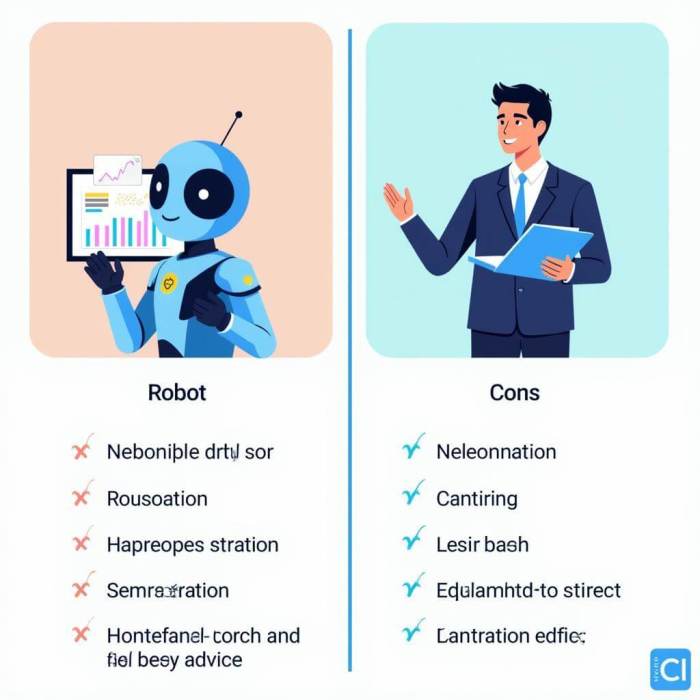
The investment strategies employed by Robo-advisors and human advisors differ significantly, reflecting their distinct approaches to portfolio management. Robo-advisors typically follow a passive investment strategy, while human advisors may employ a combination of passive and active strategies, depending on the client’s needs and preferences. Here’s a detailed comparison:
- Robo-Advisors:
- Asset Allocation: Robo-advisors typically use a diversified asset allocation strategy, allocating investments across various asset classes (stocks, bonds, real estate, commodities) based on the client’s risk tolerance and investment timeline.
- Risk Management: Risk management is primarily achieved through diversification and periodic rebalancing. Portfolios are rebalanced automatically to maintain the target asset allocation. Tax-loss harvesting is often used to minimize tax liabilities.
- Investment Selection: Robo-advisors primarily invest in low-cost ETFs that track broad market indexes. This passive approach aims to replicate market returns.
- Example: A Robo-advisor might allocate a client’s portfolio as follows: 60% stocks (e.g., S&P 500 ETF, international stock ETF), 30% bonds (e.g., U.S. Treasury bond ETF, corporate bond ETF), and 10% real estate or commodities.
- Human Advisors:
- Asset Allocation: Human advisors can customize asset allocation strategies based on the client’s specific needs, risk tolerance, and goals. They may consider a wider range of asset classes and investment options.
- Risk Management: Human advisors use a combination of diversification, asset allocation, and active management to manage risk. They may adjust the portfolio based on market conditions and client needs.
- Investment Selection: Human advisors can select from a broader range of investments, including individual stocks, bonds, mutual funds, and alternative investments. They may use active or passive strategies.
- Example: A human advisor might allocate a client’s portfolio as follows: 50% stocks (including individual stocks and mutual funds), 30% bonds, 10% alternative investments (e.g., private equity), and 10% cash. The advisor may actively manage the stock portion of the portfolio, selecting individual stocks based on fundamental analysis.
The key difference is the level of customization and the investment approach. Robo-advisors offer a standardized, passive approach, while human advisors can provide a more tailored, active approach.
Historical Performance Data: A Comparative Analysis
Analyzing historical performance data can provide valuable insights into the potential returns of Robo-advisors and human advisors. However, it’s essential to remember that past performance is not indicative of future results. Market conditions and investment objectives play a crucial role in shaping investment outcomes. Here’s a comparative analysis:
- Robo-Advisors:
- Performance: Robo-advisors’ performance is generally in line with their benchmark indexes, such as the S&P 500 or the total bond market index.
- Factors: Performance is influenced by market conditions, asset allocation, and the expense ratios of the underlying ETFs.
- Data: Many Robo-advisors provide historical performance data on their websites. You can also compare their performance to relevant market indexes.
- Example: If the S&P 500 returned 15% in a given year, a Robo-advisor with a similar asset allocation might have achieved a return close to that figure, minus its fees.
- Human Advisors:
- Performance: Human advisors’ performance varies based on their investment strategies, expertise, and market timing skills. Some may outperform their benchmarks, while others may underperform.
- Factors: Performance is influenced by market conditions, asset selection, portfolio management skills, and the advisor’s ability to manage risk.
- Data: Some human advisors provide historical performance data, but it’s often more difficult to compare their performance to benchmarks. The data may be based on a model portfolio or the average performance of their clients.
- Example: A human advisor with an active management strategy might have achieved a return of 20% in a given year by selecting specific stocks or mutual funds. However, their performance could also be lower than the market if their investment decisions were not successful.
It’s important to evaluate performance data carefully, considering factors such as market conditions, investment objectives, and the fees charged. Remember that past performance is not a guarantee of future results.
Factors Influencing Investment Performance
Several factors can influence investment performance, including market volatility, investment selection, and the advisor’s ability to navigate challenges. Both Robo-advisors and human advisors face these challenges, but their approaches differ. Let’s look at how each type of advisor handles these factors:
- Market Volatility:
- Robo-Advisors: Robo-advisors typically use diversification and rebalancing to manage market volatility. During market downturns, they may automatically rebalance portfolios, selling some assets and buying others to maintain the target asset allocation.
- Human Advisors: Human advisors can adjust portfolios based on market conditions, potentially reducing exposure to risky assets during downturns. They can also provide emotional support and guidance to help clients stay invested during volatile periods.
- Investment Selection:
- Robo-Advisors: Robo-advisors typically invest in low-cost ETFs that track broad market indexes. This passive approach reduces the risk of underperforming the market due to poor investment selection.
- Human Advisors: Human advisors can select from a wider range of investments, including individual stocks, bonds, and mutual funds. Their investment selection skills can impact performance.
- Expert Opinions:
“In volatile markets, the ability to stay the course and avoid emotional decision-making is critical. Human advisors can provide the support and guidance needed to help clients stay invested during challenging times.”
Financial Advisor
- Navigating Challenges: Both types of advisors face challenges in managing investments during market volatility and economic uncertainty. The key is to have a well-defined investment strategy and the discipline to stick to it.
Understanding these factors and how each type of advisor addresses them is essential for making informed investment decisions. Consider your risk tolerance, investment knowledge, and the level of support you need when choosing an advisor.
End of Discussion
In conclusion, the choice between a robo-advisor and a human advisor hinges on your individual needs and circumstances. Robo-advisors offer a cost-effective, tech-driven solution ideal for those comfortable with self-service and seeking simplicity. Human advisors provide a personalized experience with in-depth planning for complex situations. Weighing these factors carefully will empower you to select the advisor that best supports your financial journey.
Frequently Asked Questions
What exactly is a Robo-Advisor?
A robo-advisor is an automated online platform that provides financial advice and investment management services with minimal human intervention. They typically use algorithms to create and manage investment portfolios based on your risk tolerance and financial goals.
Are Robo-Advisors suitable for everyone?
Robo-advisors are often a good fit for individuals with straightforward financial needs, a willingness to manage their investments online, and a preference for lower fees. They might not be the best choice for those with complex financial situations requiring personalized advice.
What are the main advantages of using a human financial advisor?
Human advisors offer personalized financial planning, including complex estate planning, tax optimization, and emotional support during market volatility. They can also provide a deeper understanding of your financial situation and tailor strategies to your unique circumstances.
How do fees compare between Robo-Advisors and human advisors?
Robo-advisors generally charge lower fees, typically a percentage of assets under management (AUM). Human advisors may have various fee structures, including commissions, fee-only, or a combination, often resulting in higher overall costs, especially for smaller portfolios.
