Choosing the right retirement plan is a big deal for small business owners. SEP IRAs and SIMPLE IRAs are two popular options, but figuring out which one is best for your business can feel overwhelming. This guide breaks down the key differences between these plans, helping you understand their ins and outs so you can make a smart decision for your future and your employees’ futures.
We’ll cover everything from eligibility requirements and contribution limits to administrative burdens and investment options. By the end, you’ll have a clear understanding of how each plan works, allowing you to choose the one that aligns best with your business goals and long-term financial planning.
SEP vs. SIMPLE IRA: The Best Retirement Choice for Your Small Business
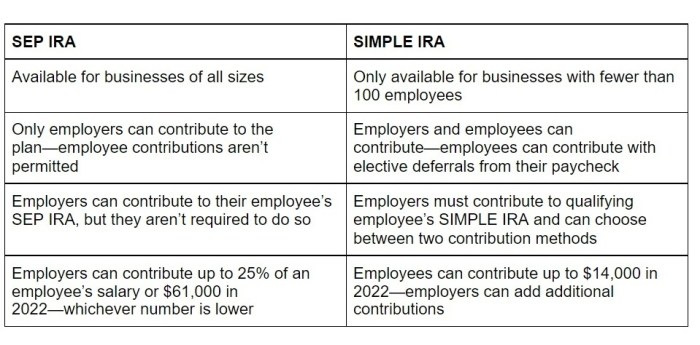
Choosing the right retirement plan is a critical decision for small business owners. Two popular options, SEP IRAs and SIMPLE IRAs, offer distinct advantages and disadvantages. Understanding these differences is essential for selecting the plan that best aligns with your business structure, financial goals, and administrative capabilities. This guide provides a comprehensive comparison of SEP and SIMPLE IRAs, helping you make an informed decision for your retirement planning needs.
Let’s dive in and explore the key considerations for each plan.
Understanding the Fundamental Differences Between SEP and SIMPLE IRAs is Crucial for Business Owners
The foundation of a sound retirement plan lies in understanding its core requirements. Both SEP and SIMPLE IRAs have specific eligibility rules that businesses must meet. Grasping these fundamentals is crucial to ensure you and your employees can participate and benefit from the plan.
To establish a SEP IRA, your business must meet certain criteria. Generally, any business structure, including sole proprietorships, partnerships, LLCs, and corporations, can set up a SEP IRA. There’s no minimum or maximum employee count requirement, making it accessible for businesses of all sizes, even those with just one employee (the owner). Regarding compensation, contributions can be based on various types, including salary, wages, commissions, and bonuses.
The IRS defines eligible compensation broadly, ensuring that a wide range of earnings can be considered for contribution purposes. However, the plan must be offered to all eligible employees, including those who have worked for the business for a certain period and meet the age requirements set by the IRS. This promotes fairness and ensures that all qualifying employees can benefit from the plan.
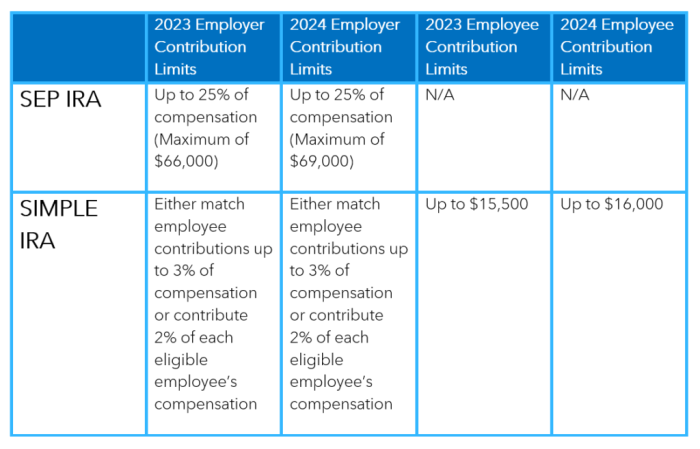
Here’s a detailed comparison of contribution limits for the current tax year, highlighting the differences between SEP IRAs and SIMPLE IRAs:
- SEP IRA:
- Employer Contributions: Employers can contribute up to 25% of an employee’s compensation or up to a specific dollar amount, adjusted annually for inflation (e.g., $69,000 for 2024).
- Employee Contributions: Employees cannot make additional contributions to a SEP IRA.
- SIMPLE IRA:
- Employer Contributions: Employers can choose between two contribution methods:
- Matching Contribution: Employers match employee contributions dollar-for-dollar up to 3% of the employee’s compensation.
- Non-elective Contribution: Employers can choose to contribute a fixed percentage (up to 2% of compensation) for all eligible employees, regardless of whether the employees contribute.
- Employee Contributions: Employees can contribute a percentage of their compensation to the SIMPLE IRA. The employee contribution limit is adjusted annually, with an additional “catch-up” contribution allowed for those aged 50 or older.
Let’s illustrate how a business owner with a small team might calculate contributions to a SEP IRA. Imagine a business owner, Sarah, with three employees. Sarah’s annual compensation is $100,000, and her employees’ salaries are $50,000, $40,000, and $30,000, respectively. Sarah decides to contribute 10% of compensation for herself and her employees. Here’s the calculation:
- Sarah’s Contribution: 10% of $100,000 = $10,000
- Employee 1’s Contribution: 10% of $50,000 = $5,000
- Employee 2’s Contribution: 10% of $40,000 = $4,000
- Employee 3’s Contribution: 10% of $30,000 = $3,000
- Total Contribution: $10,000 + $5,000 + $4,000 + $3,000 = $22,000
In this example, Sarah contributes $10,000 for herself and $12,000 for her employees, demonstrating the potential for significant contributions to a SEP IRA.
Evaluating the Contribution and Funding Processes for Each Retirement Plan is Necessary
Understanding the procedures for making contributions and adhering to deadlines is essential for maintaining compliance and ensuring the smooth operation of your retirement plan. Both SEP and SIMPLE IRAs have specific processes that businesses must follow. Let’s break down the details.
For SEP IRAs, contributions are made directly by the employer to each eligible employee’s SEP IRA account. There is no requirement to file a specific form with the IRS when establishing a SEP IRA. However, employers are required to provide employees with a copy of the plan’s written document, which Artikels the contribution formula and other plan details. The deadline for making contributions is generally the tax filing deadline, including extensions, for the business.
For example, if your business operates on a calendar year, you have until April 15th of the following year to make contributions. If you file for an extension, you have until the extended deadline to contribute. No specific forms are required to be filed with the IRS to report contributions. However, businesses should keep records of contributions, including the amount contributed for each employee, to maintain accurate records.
It’s crucial to consult with a tax advisor or financial professional to ensure compliance and avoid penalties.
For SIMPLE IRAs, contributions are also made directly by the employer to each eligible employee’s SIMPLE IRA account. The employer must establish a SIMPLE IRA plan using IRS Form 5304-SIMPLE or Form 5305-SIMPLE. Employees can choose to contribute a percentage of their salary through salary reduction contributions, and the employer matches these contributions or makes non-elective contributions. Contributions are typically made throughout the year, usually each pay period, and are deposited into the employees’ SIMPLE IRA accounts.
There are specific deadlines for making these contributions. Employers must deposit employee salary reduction contributions as soon as reasonably possible after the date the amounts are withheld from the employees’ paychecks. The employer’s matching or non-elective contributions must be made by the due date of the employer’s tax return, including extensions. Late contributions can result in penalties. It’s essential to follow these guidelines to avoid potential penalties and maintain the plan’s tax-advantaged status.
Here’s a comparison table summarizing the contribution methods, deadlines, and potential penalties for late contributions for both SEP and SIMPLE IRAs:
| Feature | SEP IRA | SIMPLE IRA |
|---|---|---|
| Contribution Method | Employer contributes directly to each employee’s IRA account. | Employer and employee contributions (employee via salary reduction; employer matches or makes non-elective contributions) directly to each employee’s IRA account. |
| Contribution Deadline | Tax filing deadline, including extensions, for the business. | Employee contributions: As soon as reasonably possible after withholding from paychecks. Employer contributions: Due date of the employer’s tax return, including extensions. |
| Potential Penalties for Late Contributions | IRS penalties may apply if contributions are not made by the deadline. | Penalties may apply, and the plan could lose its tax-advantaged status. |
Examining the Flexibility and Administration Burdens of SEP and SIMPLE IRAs is Important
Administrative responsibilities are a critical consideration when choosing a retirement plan. The complexity and ongoing requirements can significantly impact the time and resources needed to manage the plan. Understanding these aspects is essential for ensuring that your chosen plan aligns with your business’s capabilities.
Maintaining a SEP IRA involves relatively few administrative responsibilities. Once the plan is established, the primary obligation is to make contributions according to the chosen formula. There’s no requirement to file annual reports with the IRS, which simplifies the ongoing administrative burden. Record-keeping is essential; employers must maintain records of contributions made for each employee, ensuring accurate tracking of plan assets.
Additionally, employers must communicate plan details to employees, including the contribution formula and eligibility requirements. This communication typically involves providing employees with a copy of the plan document and any updates. There are no ongoing compliance testing requirements, which further reduces the administrative workload. However, it’s advisable to review the plan periodically to ensure it continues to meet the business’s needs and complies with any changes in regulations.
The straightforward nature of a SEP IRA makes it an attractive option for businesses that want a simple and easy-to-manage retirement plan.
SIMPLE IRAs involve more administrative requirements than SEP IRAs. Employers must establish the plan using IRS Form 5304-SIMPLE or Form 5305-SIMPLE. Additionally, the employer is required to notify employees of their eligibility to participate in the plan and provide them with a summary plan description. Employers are also responsible for communicating contribution amounts to employees and providing them with an annual statement of their account balances.
SIMPLE IRAs are subject to non-discrimination testing to ensure that the plan benefits a broad range of employees, not just highly compensated employees. This involves checking that the participation rate and contribution rates meet specific IRS requirements. Employers must also keep detailed records of employee contributions and employer matching or non-elective contributions. This record-keeping is essential for compliance and reporting purposes.
While the administrative responsibilities of a SIMPLE IRA are greater than those of a SEP IRA, they are still manageable for many small businesses. It is important to carefully consider the administrative demands when choosing between a SEP IRA and a SIMPLE IRA to ensure the plan fits your business’s resources and capabilities.
Here’s a list of the advantages and disadvantages of each plan regarding administrative complexity:
- SEP IRA:
- Advantages:
- Minimal paperwork and reporting requirements.
- No annual filings with the IRS.
- Easy to set up and maintain.
- Disadvantages:
- Limited flexibility to adjust contribution rates year to year.
- Employee participation is not as easily encouraged.
- SIMPLE IRA:
- Advantages:
- Allows for employee contributions, increasing employee participation.
- Potentially easier to communicate and promote.
- Disadvantages:
- More administrative tasks, including annual filings and compliance testing.
- Requires ongoing employee communication.
Assessing the Employee Participation and Benefit Aspects of Retirement Plans is Essential

The level of employee participation and the benefits offered are critical factors in evaluating a retirement plan. The rules governing who is eligible to participate and the impact on employee satisfaction and retention are essential considerations. Let’s examine these aspects for both SEP and SIMPLE IRAs.
For a SEP IRA, employee eligibility is relatively straightforward. Generally, an employee is eligible if they have reached the age of 21, have worked for the employer for at least three of the past five years, and have received at least a certain amount of compensation from the employer during the year (the IRS sets this amount annually). These requirements ensure that the plan includes long-term employees and those who have a significant connection to the business.
Employers must include all eligible employees in the plan, including themselves. However, there is some flexibility in the plan design. Employers can choose the contribution percentage, but it must be applied consistently to all eligible employees. The employer is not required to contribute to the plan every year, but if a contribution is made, it must be made for all eligible employees.
Understanding these requirements is essential for ensuring that the plan meets the needs of both the employer and the employees. This helps foster a positive work environment and aids in employee retention.
SIMPLE IRAs have different employee participation rules. Employees are eligible to participate if they have earned at least $5,000 in compensation during any two preceding years and are expected to earn at least $5,000 in the current year. This lower compensation threshold may make more employees eligible to participate compared to a SEP IRA. Employees are immediately eligible to participate once they meet these requirements.
Employees can choose to contribute a percentage of their salary to the plan through salary reduction, and the employer matches these contributions or makes non-elective contributions. Employers must include all eligible employees in the plan, but employees can choose whether or not to contribute. These rules are designed to encourage employee participation and make the plan attractive to employees. The immediate eligibility and employee contribution options can lead to higher participation rates, enhancing the plan’s value as an employee benefit.
Let’s consider a hypothetical scenario to illustrate the impact of different participation rates on a SEP IRA compared to a SIMPLE IRA. Imagine a business with ten employees. In a SEP IRA, if the employer contributes 10% of compensation, and only 50% of employees are highly engaged with retirement planning, the overall cost might be lower, but the benefits may be limited.
If the employer contributes 3% for a SIMPLE IRA, with a 75% employee participation rate, the cost may be higher. However, the plan could provide greater employee satisfaction and retirement savings. The employer benefits from tax deductions for contributions in both scenarios. Employees in the SIMPLE IRA may benefit from both employer matching contributions and their own contributions, potentially leading to higher retirement savings.
The choice between these two plans depends on the business’s goals, budget, and desired level of employee participation. A higher participation rate in the SIMPLE IRA could lead to greater employee satisfaction and help the business attract and retain talent.
Understanding the Investment Choices and Growth Potential within Each Plan is Significant
The investment options available within a retirement plan are crucial for maximizing the potential for growth. The range of investment choices can vary depending on the plan type and the financial institution managing the account. Let’s explore the typical investment options for SEP and SIMPLE IRAs.
SEP IRAs offer a wide array of investment options. The investment choices typically mirror those available within traditional IRAs, providing flexibility for participants to tailor their investment strategies. These options often include stocks, bonds, mutual funds, and exchange-traded funds (ETFs). The specific investment choices depend on the financial institution where the SEP IRA is established. Some institutions offer a broader selection of investment products, while others may have a more limited menu.
Participants can choose investments based on their risk tolerance, time horizon, and financial goals. For example, a younger employee with a long time horizon might choose to invest a more significant portion of their portfolio in stocks, while an older employee nearing retirement might opt for a more conservative mix of bonds and other fixed-income investments. This flexibility allows participants to diversify their portfolios and potentially maximize their returns over time.
It’s essential to research and select a financial institution that provides a range of investment options and offers the support and resources needed to make informed investment decisions. This might involve consulting with a financial advisor who can provide guidance on asset allocation and investment selection.
SIMPLE IRAs typically offer a more limited range of investment options compared to SEP IRAs. The investment choices are often restricted to mutual funds and other diversified investment vehicles. This simplification aims to make the plan easier to administer and provides participants with a straightforward investment approach. The specific investment options depend on the financial institution or brokerage firm managing the SIMPLE IRA accounts.
The investment choices typically include a selection of mutual funds, such as stock funds, bond funds, and balanced funds. Participants can choose from these options based on their risk tolerance and financial goals. The selection of funds often focuses on low-cost, diversified investment options, which can help participants build a well-rounded portfolio. While the investment options in a SIMPLE IRA may be less extensive than in a SEP IRA, they still provide participants with the opportunity to grow their retirement savings over time.
It’s essential for participants to review the available investment options and select those that align with their investment objectives. The investment choices offered in a SIMPLE IRA are generally designed to be easy to understand and manage, making them accessible for participants who may not have extensive investment experience.
Imagine a business owner, Sarah, who has a SEP IRA with $50,000. She invests 60% in a diversified stock index fund, which averages a 10% annual return, and 40% in a bond fund, which averages a 5% annual return. Over 20 years, assuming consistent returns, her investment portfolio could grow significantly. In contrast, if she had a SIMPLE IRA with a similar initial investment but more conservative options, the growth might be slightly less due to the lower average returns of the available funds. However, the impact of compounding over time can still lead to substantial growth in either scenario.
Image Description: A simple bar graph showing the potential growth of a SEP IRA and a SIMPLE IRA over 20 years, highlighting the impact of different investment strategies and market conditions. The SEP IRA, with higher-growth investment options, shows a slightly steeper upward trend, indicating potentially higher returns over time.
Exploring the Impact of Withdrawals and Rollovers on SEP and SIMPLE IRAs is Necessary
Understanding the rules surrounding withdrawals and rollovers is essential for managing your retirement savings effectively. These rules can significantly impact your financial planning and tax liabilities. Let’s examine the specific regulations for both SEP and SIMPLE IRAs.
Withdrawals from a SEP IRA are generally subject to the same rules as traditional IRAs. Withdrawals made before age 59 ½ are usually subject to a 10% early withdrawal penalty, in addition to regular income tax. There are exceptions to this penalty, such as for qualified medical expenses, higher education expenses, or first-time home purchases. The tax implications of distributions from a SEP IRA are straightforward; the distributions are taxed as ordinary income in the year they are received.
This means the amount withdrawn is added to your gross income, and you pay taxes at your applicable tax rate. It’s important to consider the tax implications and potential penalties before withdrawing funds from your SEP IRA. Proper planning and understanding of the rules can help you avoid unnecessary tax liabilities and penalties. Consulting with a financial advisor or tax professional is recommended to understand the specific implications of withdrawals in your situation.
Withdrawals from a SIMPLE IRA also follow the general rules for traditional IRAs. Withdrawals made before age 59 ½ are subject to a 10% early withdrawal penalty, in addition to regular income tax. However, there is a special rule for SIMPLE IRAs. If a withdrawal is made within the first two years of the plan’s participation, the early withdrawal penalty is increased to 25%.
This higher penalty is designed to encourage participants to keep their funds in the plan for a longer period. The tax implications of distributions from a SIMPLE IRA are similar to those of a SEP IRA; the distributions are taxed as ordinary income in the year they are received. Before making any withdrawals, it’s crucial to understand the tax implications and potential penalties.
Consulting with a financial advisor or tax professional is advisable to determine the best course of action for your financial situation. It can help you make informed decisions and avoid potential tax consequences.
Rolling over funds from a SEP IRA to another retirement account is a relatively straightforward process. You can roll over funds to another SEP IRA, a traditional IRA, or a 401(k) plan. There are no taxes or penalties as long as the rollover is completed within 60 days of receiving the funds. The process involves instructing the financial institution holding the SEP IRA to transfer the funds directly to the new account.
With a SIMPLE IRA, the rollover process is similar. You can roll over funds to another SIMPLE IRA, a traditional IRA, or a 401(k) plan. As with SEP IRAs, there are no taxes or penalties as long as the rollover is completed within 60 days. It is important to note that you can only roll over funds from a SIMPLE IRA to another SIMPLE IRA after the two-year period has passed.
Direct rollovers are recommended to avoid any potential tax implications. Understanding the procedures for rollovers is crucial for managing your retirement savings and ensuring that your funds continue to grow tax-deferred.
Considering the Long-Term Financial Planning Implications of Each Retirement Plan is Important
Choosing between a SEP IRA and a SIMPLE IRA has long-term financial planning implications that extend beyond immediate tax benefits. The plan you select can influence your retirement income, estate planning goals, and overall financial well-being. Let’s delve into the long-term considerations for each plan.
When considering a SEP IRA, the long-term implications are centered around the flexibility it offers. The ability to adjust contribution rates year to year, depending on your business’s financial performance, can be advantageous. If your business experiences a profitable year, you can contribute the maximum amount allowed, accelerating your retirement savings. Conversely, if your business faces financial challenges, you are not obligated to contribute, providing flexibility to manage cash flow.
This flexibility can be beneficial for business owners whose income fluctuates. SEP IRAs also offer simplicity in estate planning. The assets held in a SEP IRA are part of your estate and will be distributed according to your will or other estate planning documents. This makes it relatively straightforward to integrate the SEP IRA into your overall estate plan. However, the lack of employee contribution options can be a disadvantage in the long term.
Without the ability for employees to contribute, the plan may not foster as much employee engagement and may not be as attractive as a benefit. The choice between a SEP IRA and other retirement plans depends on your business’s financial situation, employee demographics, and long-term financial goals.
The long-term financial planning considerations for a SIMPLE IRA are somewhat different. SIMPLE IRAs provide an opportunity for employees to contribute, which can increase the total retirement savings. This can lead to greater employee satisfaction and may help in attracting and retaining talent. The employer contributions, whether matching or non-elective, can also significantly boost retirement savings. SIMPLE IRAs may be more attractive to employees because they have the ability to contribute to the plan.
This can lead to a higher overall savings rate and potentially a more comfortable retirement for employees. However, the administrative burdens of a SIMPLE IRA are higher than those of a SEP IRA. The need for employee communication, non-discrimination testing, and annual filings can add to the time and resources required to manage the plan. This is an important consideration for business owners.
The choice between a SIMPLE IRA and other retirement plans depends on your business’s goals, employee demographics, and administrative capabilities. A SIMPLE IRA may be the best choice for businesses that want to encourage employee participation and offer a competitive retirement benefit, even if it requires more administrative effort.
Here’s a list of the potential tax advantages and disadvantages of each plan in the long term:
- SEP IRA:
- Tax Advantages:
- Tax-deductible contributions for the employer.
- Tax-deferred growth of investments.
- Simple to set up and administer.
- Tax Disadvantages:
- No employee contributions.
- Less flexibility to adjust contribution rates.
- SIMPLE IRA:
- Tax Advantages:
- Tax-deductible contributions for the employer.
- Tax-deferred growth of investments.
- Employee contributions allowed.
- Tax Disadvantages:
- Higher administrative costs.
- More complex compliance requirements.
To assess the suitability of each plan, consider these factors: your business’s size, employee demographics, financial goals, and risk tolerance. If you’re a sole proprietor or have a small team and want simplicity, a SEP IRA might be best. If you want to encourage employee participation and have the resources to handle more administration, a SIMPLE IRA could be a better choice.
Assess your age and risk tolerance; younger individuals with a longer time horizon may prefer higher-growth investments, while those nearing retirement might opt for more conservative options. Regularly review your plan and make adjustments as needed to ensure it continues to meet your needs and financial objectives. Seek advice from a financial advisor or tax professional to make an informed decision and create a retirement plan that aligns with your long-term goals.
Last Point

In short, both SEP and SIMPLE IRAs offer valuable ways for small business owners to save for retirement and provide benefits to their employees. Understanding the nuances of each plan – from contribution rules and administrative complexities to investment choices and withdrawal regulations – is key. Ultimately, the “best” choice depends on your specific business needs, financial goals, and the level of employee participation you anticipate.
Weighing these factors carefully will help you select the retirement plan that sets you and your team up for a secure financial future.
Key Questions Answered
What’s the main difference between a SEP IRA and a SIMPLE IRA?
The biggest difference is how contributions are made. With a SEP IRA, you (the employer) make contributions. With a SIMPLE IRA, both you and your employees can contribute, and it has simpler administration.
Are there any employee eligibility requirements for a SEP IRA?
Generally, employees who have worked for you for at least three of the last five years and are at least 21 years old are eligible to participate. You must contribute the same percentage of compensation for all eligible employees.
Can I contribute to both a SEP IRA and a SIMPLE IRA?
No, you can’t have both plans. You must choose one or the other. This is because they serve similar purposes for retirement savings.
What happens if I miss a contribution deadline?
Missing a deadline can lead to penalties. For SEP IRAs, late contributions are subject to a tax penalty. For SIMPLE IRAs, there may be penalties for both the employer and the employee.
Can I borrow money from my SEP IRA or SIMPLE IRA?
No, you generally cannot borrow money from either a SEP IRA or a SIMPLE IRA. These are designed for long-term retirement savings.
