The Triple Tax Advantage: Why Your HSA is a Secret Retirement Weapon unlocks a powerful, often overlooked tool for building a secure financial future. It’s a financial instrument that offers tax benefits at every stage: when you contribute, while your money grows, and when you withdraw it for qualified medical expenses. This unique trifecta makes HSAs a compelling option, especially when compared to traditional retirement accounts.
This guide dives deep into the world of Health Savings Accounts (HSAs), explaining how they work, who can benefit, and how to maximize their potential. We’ll explore eligibility requirements, contribution limits, investment strategies, and how to navigate the often-confusing landscape of qualified medical expenses. Whether you’re just starting your retirement planning or looking for ways to supercharge your savings, this is your roadmap to understanding and leveraging the power of the HSA.
Understanding the Core Benefits of a Health Savings Account is Crucial for Retirement Planning Success

The Health Savings Account (HSA) is often touted as a powerful tool for managing healthcare costs, but its true potential lies in its ability to supercharge your retirement savings. Unlike a traditional savings account, an HSA offers a unique trifecta of tax advantages that can significantly boost your financial security in the long run. Understanding these benefits is the first step toward unlocking the full power of an HSA.
Explain the Primary Tax Advantages of an HSA
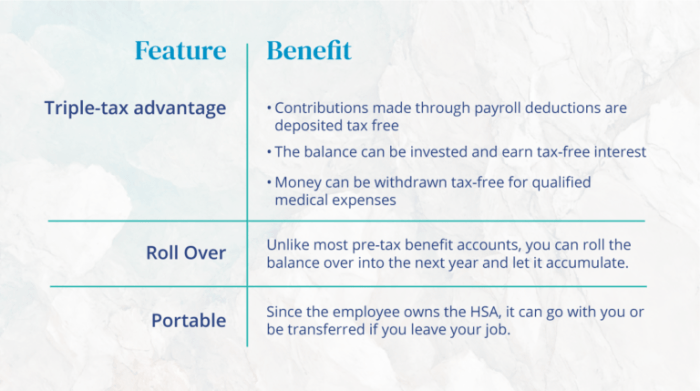
The HSA’s primary appeal lies in its triple tax advantage, a feature that distinguishes it from other savings vehicles. This means you get a tax break at three different stages: when you contribute, while your money grows, and when you withdraw it for qualified medical expenses. First, contributions to an HSA are tax-deductible. This means the money you put into your HSA reduces your taxable income, lowering your tax bill in the present.
This is similar to the tax benefits offered by traditional 401(k) or IRA plans. Second, the money in your HSA grows tax-free. Any interest, dividends, or capital gains earned within the account are not subject to taxes, allowing your investments to compound more rapidly. Finally, withdrawals for qualified medical expenses are tax-free. This means you can use the money in your HSA to pay for eligible healthcare costs without owing any taxes on the withdrawals.
This triple tax advantage makes the HSA a highly efficient savings vehicle, especially for those who anticipate significant healthcare expenses in retirement. Unlike a Flexible Spending Account (FSA), the money in an HSA rolls over year after year, allowing you to build up a substantial balance over time. While the tax benefits are attractive, it is crucial to understand that there are rules and regulations governing HSAs, and consulting with a financial advisor or tax professional is always recommended to ensure you’re maximizing the benefits while complying with all requirements.
How Tax Advantages Contribute to Long-Term Retirement Savings

The tax advantages of an HSA can significantly boost your retirement savings compared to traditional investment accounts. Let’s consider a simplified example. Imagine you contribute $3,850 (the 2023 individual contribution limit) annually to an HSA. Assuming you’re in the 22% tax bracket, you would save $847 in taxes each year (22% of $3,850). This tax savings effectively increases the amount you have available to invest.
Furthermore, any investment earnings within the HSA grow tax-free, unlike a taxable brokerage account where you’d owe taxes on capital gains and dividends each year. Over time, this tax-free growth can lead to significantly higher returns.
Consider two scenarios. In the first, you invest in a taxable brokerage account. You earn a 7% average annual return, but after taxes, your actual return is lower. In the second scenario, you invest in an HSA. Your earnings also grow at 7%, but since the growth is tax-free, your returns are higher.
This difference compounds over time, leading to a larger retirement nest egg. Finally, when you withdraw money from the HSA for qualified medical expenses in retirement, you don’t pay taxes on those withdrawals. This is different from a traditional 401(k) or IRA, where withdrawals are taxed as ordinary income. Even if you don’t need the money for medical expenses, after age 65, you can withdraw funds for any reason, although non-medical withdrawals are taxed as ordinary income.
However, you avoid the 10% penalty that typically applies to withdrawals from other retirement accounts before age 59 1/2.
Scenarios Demonstrating the HSA Triple Tax Advantage
Here are three scenarios illustrating how different individuals can benefit from the HSA triple tax advantage, and how their strategies might differ:
- Scenario 1: The Young Professional. Sarah, a 30-year-old software engineer, has a high-deductible health plan (HDHP). She’s relatively healthy and doesn’t anticipate many medical expenses. Sarah’s HSA strategy would be to maximize her annual contributions (up to the annual limit) and invest the funds aggressively in a diversified portfolio of stocks and bonds. Her focus is on long-term growth. She understands that even if she doesn’t use the money for medical expenses now, it will be available to cover those costs in retirement.
She benefits from the tax deduction now and tax-free growth over the next 30+ years. If she has excess funds when she retires, she can use them for non-medical expenses, though they will be taxed as ordinary income.
- Scenario 2: The Family with Young Children. Mark and Emily, both 40, have two young children and a family HDHP. They anticipate higher healthcare costs due to routine checkups, potential illnesses, and dental work. They would still contribute to their HSA, but they might prioritize using the funds to pay for current medical expenses. They would still invest a portion of the funds, but perhaps in more conservative investments to ensure liquidity.
They would also carefully track all qualified medical expenses to maximize their tax-free withdrawals. Their strategy balances current healthcare needs with long-term savings goals. They benefit from the tax deduction, tax-free withdrawals, and the potential for tax-free growth on any remaining balance.
- Scenario 3: The Pre-Retiree. David, 55, is nearing retirement and has a high-deductible health plan. He may have higher healthcare costs and is concerned about potential medical expenses in retirement. David would likely contribute the maximum amount allowed, including the catch-up contribution for those aged 55 and older. He may invest his funds more conservatively, focusing on preserving capital while still generating some growth.
He’d also prioritize using his HSA funds for healthcare costs in retirement, knowing that withdrawals are tax-free. He’d also use the HSA to cover Medicare premiums. David benefits from the tax deduction now and tax-free withdrawals in retirement. The catch-up contributions provide an extra boost to his savings.
Wrap-Up
In conclusion, the Triple Tax Advantage: Why Your HSA is a Secret Retirement Weapon isn’t just a savings account; it’s a strategic investment that can significantly boost your retirement readiness. By understanding the core benefits, contribution rules, investment options, and withdrawal guidelines, you can transform your HSA into a powerful asset. By planning strategically and integrating your HSA into your broader retirement strategy, you can secure your financial future and enjoy greater peace of mind knowing you’re prepared for the healthcare costs that come with retirement.
Embrace the triple tax advantage, and unlock the secret weapon for a healthier and wealthier retirement.
FAQ
What is an HSA?
An HSA, or Health Savings Account, is a tax-advantaged savings account available to individuals with a high-deductible health plan (HDHP). It’s designed to help you save for current and future healthcare expenses.
Who is eligible to open an HSA?
To be eligible, you must have an HDHP, not be covered by other health insurance that isn’t an HDHP, not be enrolled in Medicare, and not be claimed as a dependent on someone else’s tax return.
What happens to my HSA if I change jobs?
Your HSA is portable, meaning it stays with you, even if you change jobs or retire. You maintain control of the funds and can continue to use them for qualified medical expenses.
Can I use my HSA for dental or vision expenses?
Yes, dental and vision expenses, including eye exams, glasses, contact lenses, and dental work, are generally considered qualified medical expenses and can be paid for with HSA funds.
What happens if I use my HSA funds for non-qualified expenses?
If you use HSA funds for non-qualified expenses before age 65, the withdrawals are subject to income tax and a 20% penalty. After age 65, withdrawals for non-medical expenses are only subject to income tax.
