Planning for education can feel overwhelming, but there are tools designed to make it easier. The Coverdell Education Savings Account (ESA) is one such tool, offering a tax-advantaged way to save for qualified education expenses. Whether you’re thinking about kindergarten or college, understanding how a Coverdell ESA works can be a game-changer for your financial strategy.
This guide will explore the ins and outs of Coverdell ESAs, from eligibility requirements and contribution limits to tax benefits and withdrawal procedures. We’ll also compare it with other education savings options and address common questions, helping you decide if a Coverdell ESA is the right fit for your educational goals.
Understanding Coverdell ESA: Tax-Free Growth for K-12 and College
Coverdell Education Savings Accounts (ESAs) are a valuable tool for families looking to save for educational expenses. They offer significant tax advantages and flexibility, making them an attractive option for both K-12 and higher education funding. This article will provide a comprehensive overview of Coverdell ESAs, exploring their purpose, eligibility requirements, tax benefits, withdrawal processes, and potential drawbacks, equipping you with the knowledge to make informed decisions about your educational savings strategy.
Let’s dive in and explore the ins and outs of this powerful savings vehicle.
Discovering the Core Purpose of the Coverdell Education Savings Account
The primary goal of a Coverdell ESA is to help families save for education costs in a tax-advantaged way. Designed with flexibility in mind, these accounts can be used to cover a wide range of qualified educational expenses, from elementary school through college. Unlike some other savings plans that might be more narrowly focused, the Coverdell ESA offers a broad scope, allowing families to address diverse educational needs.
This versatility makes it a valuable tool for supporting a child’s educational journey, regardless of the specific path they choose.
Compared to other savings options, Coverdell ESAs stand out due to their specific features:
- Tax-Free Growth: Investments within a Coverdell ESA grow tax-free, and withdrawals for qualified educational expenses are also tax-free. This can significantly boost the overall return on your savings.
- Flexibility: Funds can be used for both K-12 and higher education expenses, offering flexibility as your child’s educational needs evolve.
- Wide Range of Eligible Expenses: The definition of “qualified educational expenses” is broad, encompassing tuition, fees, books, supplies, and even room and board for college students.
- Investment Options: You have control over your investments, with options like stocks, bonds, and mutual funds, allowing you to tailor your strategy to your risk tolerance and financial goals.
Here are some examples of qualified educational expenses:
- K-12 Expenses:
- Tuition and fees for private or religious schools.
- Books, supplies, and equipment needed for coursework.
- Tutoring services.
- Special needs services.
- College Expenses:
- Tuition and fees.
- Books, supplies, and equipment.
- Room and board (if the student is enrolled at least half-time).
- Computers and related technology.
Comparing Coverdell ESA with Other Educational Savings Vehicles
Choosing the right educational savings plan can be tricky. Here’s a comparison of Coverdell ESAs with other popular options, like 529 plans, to help you make an informed decision:
| Feature | Coverdell ESA | 529 Plan |
|---|---|---|
| Contribution Limits | $2,000 per beneficiary per year (combined from all contributors) | Varies by state, often very high (e.g., $300,000 – $500,000) |
| Investment Options | Wide range, including stocks, bonds, mutual funds, and ETFs. You manage the investments. | Typically offers a selection of mutual fund portfolios, often age-based. Managed by the plan provider. |
| Tax Benefits | Tax-free growth and tax-free withdrawals for qualified expenses. | Tax-free growth and tax-free withdrawals for qualified expenses. Some states offer state tax deductions or credits for contributions. |
| Eligible Expenses | K-12 and college expenses, including tuition, fees, books, supplies, and room and board. | College expenses, including tuition, fees, books, supplies, room and board, and certain K-12 expenses (up to $10,000 per year). |
| Income Limitations | Contribution eligibility phases out for high-income earners. | No income limitations for contributions. |
Unveiling Eligibility Requirements and Contribution Limits for the Coverdell ESA

To establish and maintain a Coverdell ESA, certain eligibility requirements must be met. Understanding these requirements is crucial to ensure you can take advantage of the plan’s benefits. The specifics revolve around the contributor’s income and the age of the beneficiary.
Here’s a breakdown of the key eligibility requirements:
- Income Limitations: There are income limitations for contributors. For 2024, if your modified adjusted gross income (MAGI) is above a certain threshold (e.g., $110,000 for single filers, $220,000 for those married filing jointly), your ability to contribute may be limited or eliminated. This is a crucial factor to consider. For example, if a parent’s MAGI is too high, they may not be able to contribute at all.
- Beneficiary Age: The beneficiary must be under the age of 18 at the time the contribution is made, unless they are a special needs beneficiary. This age restriction encourages early savings and can impact the overall strategy.
- Other Criteria: The beneficiary must be a U.S. citizen or a resident alien. The account must be established for the benefit of the designated beneficiary.
For instance, let’s say a parent earns $125,000 annually. Depending on the current IRS guidelines, they may not be able to contribute to a Coverdell ESA due to exceeding the income threshold. However, if the parent’s income is within the allowed range, they can open an account and contribute up to the annual limit.
Regarding contribution limits, the maximum contribution allowed to a Coverdell ESA is $2,000 per beneficiary per year, regardless of the number of contributors. It’s important to remember that this is a combined limit, meaning that the total contributions from all sources (parents, grandparents, other relatives) cannot exceed $2,000 in a given year. This limit is a significant factor in shaping the overall savings strategy.
Opening a Coverdell ESA involves several steps. Here’s a basic guide:
- Choose a Financial Institution: Select a bank, brokerage firm, or other financial institution that offers Coverdell ESAs. Research and compare different options to find one that suits your needs.
- Complete the Application: Fill out the application form provided by the financial institution. This will typically require personal information about the contributor and the beneficiary.
- Provide Documentation: You’ll likely need to provide the beneficiary’s Social Security number and your own identification.
- Select Investment Options: Decide how you want to invest the funds. Consider your risk tolerance, time horizon, and educational goals when making these choices. You can often choose from a range of investment options, such as mutual funds, ETFs, or other securities.
- Fund the Account: Make your initial contribution. You can typically contribute via check, electronic transfer, or other methods.
Understanding the Tax Advantages and Benefits Associated with the Coverdell ESA

One of the most attractive features of a Coverdell ESA is its tax advantages. These benefits can significantly reduce the overall cost of education and make saving for educational expenses more manageable. The core advantage lies in the tax-free growth of investments and tax-free withdrawals for qualified educational expenses.
Here’s a detailed look at the tax advantages:
- Tax-Free Growth: Any investment earnings within the Coverdell ESA grow tax-free. This means that your investments compound faster, as you don’t have to pay taxes on the gains each year.
- Tax-Free Withdrawals: When you withdraw funds from the Coverdell ESA to pay for qualified educational expenses, those withdrawals are also tax-free. This is a significant benefit, as it reduces the overall cost of education.
Let’s consider an example. Suppose you invest $10,000 in a Coverdell ESA, and over several years, the investments grow to $15,000. If you withdraw the full $15,000 to pay for qualified educational expenses, you won’t owe any taxes on the $5,000 in earnings. This contrasts with a taxable investment account, where you would owe taxes on the investment gains. The tax savings can be substantial, especially over the long term.
However, it’s important to be aware of potential tax implications, particularly if you don’t use the funds for qualified educational expenses. If you withdraw money for non-qualified expenses, the earnings portion of the withdrawal will be subject to income tax and a 10% penalty. Careful planning and expense tracking are crucial to avoid these penalties.
To maximize the benefits and avoid penalties, consider these strategies:
- Keep Accurate Records: Maintain detailed records of all educational expenses, including receipts and documentation.
- Plan Withdrawals Carefully: Withdraw funds only for qualified expenses and in the same year the expenses are incurred.
- Coordinate with Other Savings Plans: If you have other educational savings plans (like a 529 plan), coordinate your withdrawals to ensure you’re maximizing the tax benefits and avoiding any penalties.
Here are some common investment options available within a Coverdell ESA:
- Mutual Funds: These funds pool money from multiple investors to invest in a diversified portfolio of stocks, bonds, or other assets. They offer professional management and diversification, but also have associated fees.
- Exchange-Traded Funds (ETFs): ETFs are similar to mutual funds but trade on stock exchanges like individual stocks. They offer diversification and generally lower expense ratios than actively managed mutual funds.
- Stocks and Bonds: You can invest directly in individual stocks and bonds, providing more control over your investments. However, this also requires more research and carries a higher level of risk.
- Certificates of Deposit (CDs): CDs offer a fixed interest rate for a specific period. They are generally low-risk but may not provide as high a return as other investment options.
Navigating the Withdrawal Process and Qualified Expenses within a Coverdell ESA
Understanding the withdrawal process and what constitutes “qualified educational expenses” is crucial for effectively using your Coverdell ESA funds. Knowing how to access the funds and what expenses are covered ensures you can make the most of your savings.
The process for making withdrawals from a Coverdell ESA is relatively straightforward:
- Request the Funds: Contact the financial institution that holds your Coverdell ESA and request a withdrawal. You’ll typically need to complete a withdrawal form.
- Provide Documentation: You may need to provide documentation to support the qualified educational expenses, such as receipts, invoices, or enrollment records.
- Methods of Receiving Funds: Funds can be sent to you (the account holder) or directly to the educational institution.
- Timelines: The processing time for withdrawals can vary depending on the financial institution. Allow sufficient time for the funds to be available when needed.
Here’s a detailed breakdown of what qualifies as educational expenses:
- K-12 Qualified Expenses:
- Tuition and fees for elementary or secondary schools (public, private, or religious).
- Books, supplies, and equipment required for enrollment or attendance.
- Expenses for tutoring, special needs services, and other related costs.
- College Qualified Expenses:
- Tuition and fees at an eligible educational institution.
- Books, supplies, and equipment.
- Room and board (if the student is enrolled at least half-time).
- Computers, software, and internet access (for use by the student).
Properly documenting and tracking these expenses is essential for tax purposes. Keep all receipts and records, and be sure to match the expenses to the withdrawals. This will help you substantiate your qualified expenses in case of an audit.
Scenario 1: K-12 School Supplies
A parent uses their Coverdell ESA to purchase school supplies, such as notebooks, pens, and textbooks, for their child attending private elementary school. The funds can be used directly for these purchases, and the parent must keep receipts to document the qualified expenses.
Scenario 2: Tutoring Services
A high school student needs tutoring in mathematics. The parent uses the Coverdell ESA to pay for tutoring services. The funds can be used to pay the tutor directly, or the parent can pay the tutor and then reimburse themselves from the ESA. Documentation of the tutoring services, such as invoices or receipts, is required.
Scenario 3: College Tuition
A student is enrolled in a four-year university. The parent uses the Coverdell ESA to pay for the student’s tuition. The funds can be used directly to pay the university or be reimbursed to the parent. The parent must provide documentation of the tuition expenses, such as a bill or statement from the university.
Considering the Potential Downsides and Limitations of a Coverdell ESA
While Coverdell ESAs offer numerous advantages, it’s essential to be aware of their potential downsides and limitations to make a well-rounded financial plan. Understanding these aspects helps you make an informed decision and manage your expectations.
Here are some potential drawbacks:
- Low Contribution Limits: The annual contribution limit of $2,000 per beneficiary is relatively low compared to other educational savings plans, such as 529 plans. This may limit the total amount you can save over time.
- Income Restrictions: The income limitations for contributors can restrict eligibility, especially for higher-income earners. If your income exceeds the threshold, you may not be able to contribute to a Coverdell ESA.
- Limited Investment Options: While you have control over your investments, the investment options offered by some financial institutions may be limited compared to other investment vehicles.
- Tax Implications: If the funds are not used for qualified educational expenses, the earnings portion of the withdrawal is subject to income tax and a 10% penalty.
- Beneficiary Age Restriction: The beneficiary must be under 18 at the time of contribution (unless they are a special needs beneficiary). This means you cannot open a Coverdell ESA for an adult.
Let’s compare Coverdell ESAs with 529 plans, a popular alternative:
- 529 Plans: These plans typically have higher contribution limits, offering more opportunities for significant savings. Many states offer tax deductions or credits for contributions, and the investment options are often broader. However, 529 plans may have higher fees and more complex investment strategies.
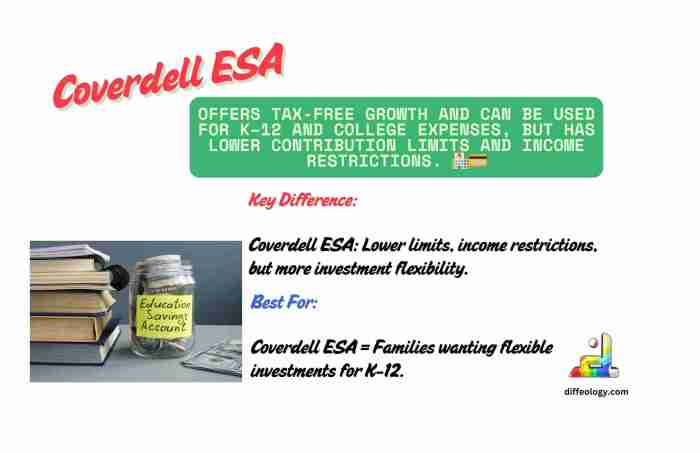
- Coverdell ESAs: While offering flexibility in the use of funds for both K-12 and higher education, the lower contribution limits and income restrictions can be a disadvantage. However, they provide tax-free growth and tax-free withdrawals for qualified expenses.
Here are some frequently asked questions (FAQs) about Coverdell ESAs:
- What happens if the funds are not used? The funds can be transferred to another eligible family member (e.g., a sibling) or used for the beneficiary’s future educational expenses. If the funds are not used, and there is no eligible beneficiary, the earnings portion of the withdrawal will be subject to income tax and a 10% penalty.
- Can I contribute to both a Coverdell ESA and a 529 plan? Yes, you can contribute to both a Coverdell ESA and a 529 plan for the same beneficiary. However, be mindful of the overall contribution limits and tax implications.
- Are there any age limits for using the funds? Yes, the funds generally must be used by the time the beneficiary reaches a certain age, often the early to mid-thirties, though the specifics may vary depending on the plan.
- Can I use the funds for online courses? Yes, qualified educational expenses include tuition, fees, books, supplies, and equipment required for enrollment or attendance at an eligible educational institution, including online courses.
Final Thoughts
In conclusion, the Coverdell ESA offers a valuable opportunity to save for education with tax advantages. By understanding the rules, benefits, and limitations, you can make informed decisions about your educational savings plan. Whether you’re a parent, guardian, or simply planning for your own future, a Coverdell ESA can be a powerful tool in achieving your educational aspirations.
Question Bank
Who can open a Coverdell ESA?
Anyone can contribute to a Coverdell ESA for a child, as long as the contributor’s modified adjusted gross income (MAGI) is below a certain limit. The beneficiary must be under 18 or have special needs.
What happens if the money isn’t used?
The funds can be transferred to another eligible family member (like a sibling) or rolled over into another Coverdell ESA. If the beneficiary doesn’t pursue education, the funds are subject to taxes and penalties if withdrawn for non-qualified expenses.
Are there any investment restrictions?
No, there are no specific investment restrictions, allowing you to choose from a wide range of investment options, such as stocks, bonds, mutual funds, and ETFs. However, it’s wise to consider your risk tolerance and time horizon.
Can I use a Coverdell ESA for room and board?
Yes, room and board are considered qualified expenses if the student is enrolled at least half-time at an eligible educational institution.
